The Top 7 Best Trees for Small Yards in 2026
Choosing a tree for a small yard is a high-stakes decision. The wrong choice can quickly overwhelm your space, creating a dense canopy that blocks all light, invasive roots that threaten foundations, and a constant, demanding pruning schedule. A poorly selected tree can become a liability rather than an asset, eventually requiring costly removal.
Conversely, the right tree becomes the soul of your garden. It acts as a living sculpture that adds significant value, four-season beauty, and practical function without compromise. It can provide just enough shade for a reading nook, a stunning focal point visible from your kitchen window, or a burst of spring color that defines your home's curb appeal. This is why careful selection is not just an aesthetic choice; it’s a long-term investment in your property.
This guide moves beyond generic advice to give you a detailed, practical roadmap for selecting the perfect specimen. We will explore the best trees for small yards, focusing on specific, high-performing cultivars renowned for their manageable size and exceptional ornamental qualities. You will learn not just what to plant, but how to plant it for maximum impact.
To eliminate the guesswork entirely, we will also show you how to apply AI landscape design to your decision-making. Using an app like DreamzAR, you can take a photo of your actual yard and instantly visualize how each of these top-tier trees will look in your space. This powerful tool allows you to test placements, compare sizes at maturity, and see how a tree complements your home's architecture before you ever break ground, ensuring your final choice is a perfect fit.
1. Japanese Maple (Acer palmatum)
The Japanese Maple is the quintessential small ornamental tree, revered for its graceful form, delicate foliage, and breathtaking seasonal color. Native to East Asia, Acer palmatum varieties offer an incredible range of sizes, shapes, and colors, making them one of the most versatile and best trees for small yards. Their elegant, sculptural branching provides visual interest even in winter, ensuring they serve as a year-round focal point.
Most cultivars grow slowly, reaching a mature height of 15 to 25 feet with a similar spread, though many dwarf and weeping varieties stay much smaller. This controlled growth habit means they won't overwhelm your space or cast excessive shade on your home or neighboring plants.
Why It's a Top Choice for Compact Spaces
The primary appeal of the Japanese Maple lies in its architectural beauty and non-invasive root system. The roots are generally fibrous and shallow, posing little threat to foundations, patios, or underground utilities, a critical feature for tight urban and suburban lots. This makes it an excellent choice for foundation plantings, courtyard gardens, or as a stunning specimen in a mixed border.
Their relatively small canopy allows sunlight to filter through, enabling you to grow a variety of companion plants beneath them. This quality is perfect for creating layered, textured garden designs. For homeowners seeking inspiration on how to integrate these trees, exploring landscape design ideas for small yards can provide a wealth of creative placement strategies. You can apply AI Landscape Design to visualize these ideas using photos of your own yard, seeing how a Japanese Maple looks before you commit.
Recommended Cultivars
‘Bloodgood’: One of the most popular upright varieties, known for its reliable deep reddish-purple leaves that turn a brilliant crimson in the fall. It typically reaches 15-20 feet tall.
‘Emperor I’: Similar to 'Bloodgood' but with foliage that emerges later in spring, helping it avoid damage from late frosts.
Weeping Varieties (Dissectum group): Cultivars like 'Crimson Queen' (red) and 'Viridis' (green) have a cascading, mushroom-like shape and finely cut, lace-like leaves. They rarely exceed 8-10 feet in height, making them perfect for containers or small garden beds.
Care and Placement Tips
Sunlight: Plant in a location that receives morning sun and afternoon shade, especially in hotter climates (zones 7-8), to prevent the delicate leaves from scorching.
Soil: They thrive in well-drained, slightly acidic soil. Amend heavy clay or sandy soils with compost to improve structure and moisture retention.
Watering: Keep the soil consistently moist but not waterlogged. A 2-3 inch layer of mulch helps retain moisture and protect the shallow roots.
Pruning: Minimal pruning is needed. Simply remove any dead, damaged, or crossing branches in late winter or early spring before the leaves emerge.
Visualize Before You Plant: The sheer variety of Japanese Maples can be overwhelming. You can apply AI Landscape Design to visualize your ideas using photos of your own yard. Using an AI tool like DreamzAR, you can virtually place different cultivars to see how an upright 'Bloodgood' compares to a weeping 'Crimson Queen' right next to your patio and even visualize its stunning fall color before you commit.
2. Crape Myrtle (Lagerstroemia indica)
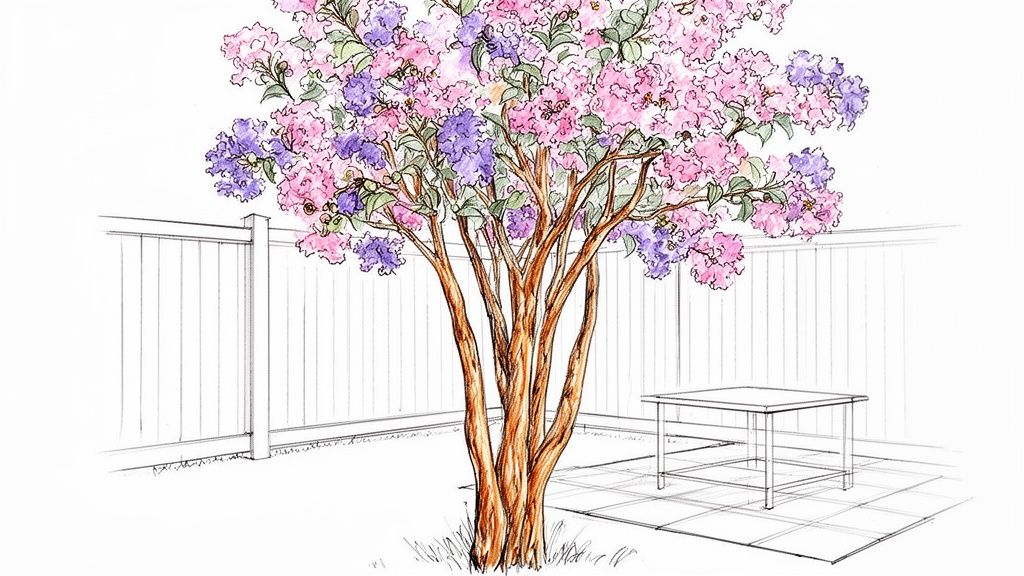
Often called the "lilac of the South," the Crape Myrtle is a spectacular flowering tree celebrated for its incredibly long-lasting summer blooms and striking multi-season appeal. Native to Southeast Asia, Lagerstroemia indica varieties are workhorses in the landscape, providing months of vibrant color in shades of pink, red, purple, and white. Beyond its prolific flowers, this tree offers beautiful exfoliating bark in tones of cream, tan, and cinnamon, creating significant visual interest long after the leaves have fallen.
Most standard cultivars grow to a manageable height of 15 to 25 feet, but an extensive range of dwarf varieties are available that stay as compact as 3 to 6 feet tall. This versatility in size makes the Crape Myrtle one of the best trees for small yards, fitting perfectly into nearly any sunny spot without overwhelming the space.
Why It's a Top Choice for Compact Spaces
The Crape Myrtle's primary draw is its outstanding ornamental value and adaptable, non-aggressive root system. Its roots are fibrous and generally stay close to the surface, posing minimal risk to foundations, sidewalks, or driveways. This makes it a safe and beautiful choice for planting near structures or along property lines where space is a premium.
Its upright, vase-shaped canopy provides light, dappled shade, allowing turfgrass and sun-loving perennials to thrive underneath. This quality is ideal for homeowners who want a show-stopping focal point without sacrificing their understory garden. For those looking for creative ways to incorporate this vibrant tree, exploring small backyard garden design ideas can offer inspiration. You can apply AI Landscape Design to visualize these ideas using photos of your own yard to create a cohesive and colorful landscape.
Recommended Cultivars
‘Natchez’: A popular, larger variety reaching up to 20 feet, renowned for its pure white flowers and exceptional cinnamon-colored exfoliating bark. It also has excellent resistance to powdery mildew.
‘Tuscarora’: Known for its stunning, coral-red flowers and good disease resistance. Its new foliage often emerges with a reddish tint, adding another layer of color.
Dwarf Varieties: Cultivars like 'Pocomoke' (deep pink) and 'Chickasaw' (lavender-pink) stay under 5 feet tall, making them perfect for large containers, patio gardens, or lining a walkway.
Care and Placement Tips
Sunlight: Crape Myrtles are sun lovers. Plant them in a location that receives at least 6-8 hours of direct sunlight per day for maximum flower production.
Soil: They are adaptable to various soil types but perform best in well-drained soil. They are also quite drought-tolerant once established.
Watering: Water regularly during the first growing season to establish a deep root system. Mature trees require less frequent watering.
Pruning: Prune in late winter or early spring while the tree is dormant to remove dead wood and shape the canopy. Avoid "crape murder," the severe topping of branches, which can weaken the tree.
Visualize Before You Plant: The brilliant color of a Crape Myrtle can transform your yard, but choosing between coral-red 'Tuscarora' and pure white 'Natchez' is a big decision. You can apply AI Landscape Design to visualize your ideas using photos of your own yard. With an app like DreamzAR, you can instantly see how each variety looks next to your home. This helps you visualize the summer bloom color and the tree's scale, ensuring it perfectly complements your home’s exterior.
3. Serviceberry (Amelanchier)
The Serviceberry is a hardworking native tree that offers unparalleled four-season interest, making it one of the absolute best trees for small yards. Often sold as a single-stem tree or a multi-stemmed shrub, Amelanchier provides delicate clouds of white flowers in early spring, followed by edible, blueberry-like fruits in June. Its appeal continues with brilliant orange, red, and yellow fall foliage and concludes with elegant, smooth gray bark that stands out in the winter landscape.
Most Serviceberry varieties mature at a manageable 15 to 25 feet tall and wide, fitting comfortably into compact garden designs without overwhelming the space. Their moderate growth rate and open, airy structure allow dappled sunlight to reach plants below, supporting a lush, layered garden bed. This native champion is also a magnet for birds, who flock to its early summer berries.
Why It's a Top Choice for Compact Spaces
The primary advantage of the Serviceberry is its multi-season functionality and ecological value. Unlike many ornamental trees that offer a single show-stopping feature, the Serviceberry provides a continuous display of beauty throughout the year. Its well-behaved root system is non-aggressive, making it a safe choice for planting near patios, walkways, or foundations.
This adaptability makes it a cornerstone for various design styles, from naturalistic woodland gardens to more structured urban courtyards. It can serve as a beautiful standalone specimen, a screen when planted in a group, or an anchor in a mixed border. For homeowners looking to add both beauty and function, you can apply AI Landscape Design to visualize your ideas using photos of your own yard and exploring brilliant landscaping ideas for small spaces can highlight how a Serviceberry can become the star of a compact design.
Recommended Cultivars
‘Autumn Brilliance’ (Amelanchier x grandiflora): A popular hybrid known for its abundant spring flowers, sweet fruit, and exceptionally reliable, fiery red-orange fall color. It typically grows to about 20 feet tall.
‘R.J. Davis’ (Amelanchier laevis): A true dwarf variety perfect for tight spots, reaching only 8-10 feet in height. It offers the same four-season benefits in a much smaller package.
Columnar Varieties: Cultivars like 'Standing Ovation' have an upright, narrow form, making them ideal for slender side yards, formal entryways, or creating vertical accents in small garden beds.
Care and Placement Tips
Sunlight: Plant in full sun to partial shade. More sun will lead to better flowering, fruiting, and more vibrant fall color.
Soil: It is highly adaptable but performs best in moist, well-drained, acidic soil. It is more tolerant of wet conditions than many other small trees.
Watering: Water regularly during the first few years to establish a deep root system. Once established, it is moderately drought-tolerant.
Pruning: Prune in late winter to remove any dead, damaged, or crossing branches. If you have a multi-stem form, you can thin out older stems to encourage new growth and maintain an open shape.
Visualize Before You Plant: The Serviceberry’s year-round transformation is its greatest asset. You can apply AI Landscape Design to visualize your ideas using photos of your own yard. With a tool like DreamzAR, you can see how the spring blossoms look against your home, how the summer foliage provides light shade for a patio, and how its stunning fall color will become a focal point, all before you dig the first hole.
4. Dogwood (Cornus)
The Dogwood tree is a classic emblem of four-season beauty, celebrated for its elegant form, spectacular spring flower display, and multi-season appeal. Encompassing several species, including the native Flowering Dogwood (Cornus florida) and the robust Kousa Dogwood (Cornus kousa), these trees offer a perfect balance of size and visual impact, making them one of the best trees for small yards. Their graceful, horizontally tiered branches create a stunning silhouette against the winter sky, while their spring blooms, summer foliage, and vibrant fall color provide a year-round performance.
Most Dogwood species and cultivars mature at a manageable height of 15 to 30 feet with a similar or slightly wider spread. Their moderate growth rate ensures they become an established feature without quickly outgrowing their designated space, making them ideal for framing a house, anchoring a garden bed, or serving as an understory tree beneath larger, existing shade trees.
Why It's a Top Choice for Compact Spaces
The Dogwood's primary value in a small landscape lies in its outstanding ornamental features packed into a compact frame. Unlike large shade trees, a Dogwood’s canopy is typically open and layered, allowing dappled sunlight to reach the ground and support a lush underplanting of shade-loving perennials like hostas, ferns, and hellebores. Its root system is non-aggressive and generally stays close to the surface, posing minimal risk to foundations, walkways, or driveways.
This manageable size makes it incredibly versatile. It can be a standalone specimen in a small front lawn, an elegant corner planting, or a key part of a mixed border. Its showy spring display of white, pink, or red bracts provides a stunning focal point. You can apply AI Landscape Design to visualize your ideas using photos of your own yard and explore stunning landscaping ideas for the front of a small house to see how Dogwoods can be integrated effectively.
Recommended Cultivars
Flowering Dogwood (C. florida): The classic American dogwood. 'Cherokee Brave' offers deep pink-red bracts, while 'Appalachian Spring' is a vigorous white-flowering variety with excellent disease resistance.
Kousa Dogwood (C. kousa): Blooms about a month later than C. florida, avoiding late frosts. Known for its vase-shaped habit, exfoliating bark, and high resistance to anthracnose. 'Wolf Eyes' is a popular variegated cultivar.
Stellar Series (C. x rutgersensis): These are hybrids between C. florida and C. kousa, combining the large flowers of the former with the disease resistance of the latter. 'Stellar Pink' and 'Aurora' are excellent choices.
Care and Placement Tips
Sunlight: Prefers partial shade, particularly protection from intense afternoon sun in warmer climates (zones 7-9). Morning sun is ideal for promoting abundant blooms.
Soil: Plant in well-drained, acidic soil that is rich in organic matter. Avoid sites with poor drainage or compacted soil.
Watering: Requires consistent moisture, especially during the first few years of establishment and in periods of drought. A 2-3 inch layer of mulch will help keep the roots cool and moist.
Pruning: Dogwoods have a beautiful natural form and require very little pruning. Remove any dead, damaged, or crossing branches during dormancy in late winter.
Visualize the Bloom: A Dogwood's transformation from a bare winter structure to a cloud of spring blossoms is its signature moment. You can apply AI Landscape Design to visualize your ideas using photos of your own yard. An app like DreamzAR allows you to virtually place a 'Cherokee Brave' by your entryway or a Kousa Dogwood near your patio, seeing how its spring color will complement your home and how its mature size will fit the space before making a final decision.
5. Redbud (Cercis)
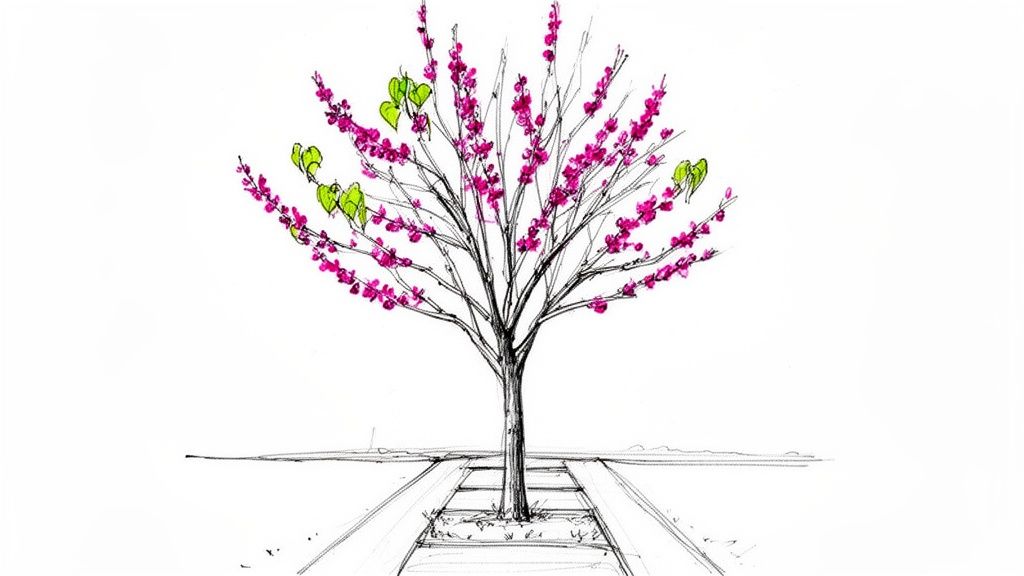
The Redbud is a beloved North American native celebrated for its explosive display of vibrant magenta-pink flowers in early spring. What makes this tree so unique is its habit of producing blossoms directly on its bare branches and even its trunk before any leaves appear. This breathtaking spectacle provides a powerful jolt of color, heralding the end of winter and making it one of the best trees for small yards seeking a dramatic seasonal show.
Typically reaching a mature height of 20 to 30 feet with a similar spread, many compact and dwarf cultivars are available that fit perfectly into smaller landscapes. Beyond its spring flowers, the Redbud offers attractive heart-shaped leaves, a pleasant yellow fall color, and an elegant, often multi-stemmed form that adds architectural interest to the winter garden.
Why It's a Top Choice for Compact Spaces
The Redbud's main draw is its unparalleled early-season floral display on a manageable frame. Its moderate size and relatively open canopy prevent it from casting dense, overpowering shade, allowing for underplantings of spring bulbs and perennials. This makes it an excellent choice for creating dynamic, multi-layered garden compositions.
Its root system is not considered aggressive, making it a safe choice for planting near patios, walkways, or foundations. As a native species, it also serves as a valuable early-season nectar source for pollinators. Homeowners looking for inspiration can create a garden design that maximizes space, and you can apply AI Landscape Design to visualize your ideas using photos of your own yard to ensure its unique features are highlighted.
Recommended Cultivars
‘Forest Pansy’: Highly prized for its deep burgundy-purple foliage that emerges after the flowers. This foliage provides a season-long color contrast long after the spring bloom has faded.
‘Appalachian Red’: A compact variety with exceptionally vibrant, deep pink-red flowers. It typically stays smaller, around 15-20 feet, making it ideal for tight spaces.
‘White Cloud’: For those who prefer a more classic look, this cultivar offers a stunning profusion of pure white flowers, creating a brilliant contrast against dark evergreens or brick siding.
Care and Placement Tips
Sunlight: Plant in full sun to light shade. More sun encourages the best flower production, but afternoon shade is beneficial in very hot climates.
Soil: Adaptable to many soil types but performs best in well-drained soil. It is fairly drought-tolerant once established.
Watering: Water regularly during its first two to three years to establish a strong root system. Provide supplemental water during extended dry periods thereafter.
Placement: Position the tree where its stunning spring bloom can be viewed from a main window, such as in the front yard or as a backyard focal point.
Visualize Before You Plant: The Redbud's most dramatic feature is its pre-leaf bloom. You can apply AI Landscape Design to visualize your ideas using photos of your own yard. An app like DreamzAR allows you to see exactly how its vibrant magenta or white flowers will pop against your home's exterior and existing landscape before the tree even has leaves, helping you find the perfect spot for that burst of spring color.
6. Crabapple (Malus cultivars)
The Crabapple is a classic and beloved choice for the small-yard landscape, celebrated for its spectacular spring flower display and multi-season interest. A member of the Malus genus, these versatile ornamental trees pack four seasons of beauty into a compact form, offering a stunning explosion of white, pink, or red blossoms in spring, attractive foliage in summer, and colorful, persistent fruit that often lasts through winter.
Most Crabapple cultivars are perfectly scaled for compact spaces, typically growing to a mature height and spread of 15 to 25 feet. Many newer and dwarf varieties remain even smaller, around 8 to 15 feet tall, making them one of the best trees for small yards where year-round visual appeal is a priority. Their generally rounded or spreading forms can be easily integrated into various landscape designs.
Why It's a Top Choice for Compact Spaces
The Crabapple’s primary advantage is its outstanding four-season interest on a manageable scale. Unlike trees that offer only a brief period of glory, a well-chosen Crabapple provides a continuous show. The spring bloom is breathtaking, the summer foliage provides pleasant shade, and the small, jewel-toned fruits add vibrant color to the stark fall and winter landscape, while also providing a valuable food source for birds.
Their root systems are non-aggressive and well-behaved, posing little risk to nearby foundations, driveways, or sidewalks. This makes them ideal for planting near a patio, along a property line, or as a focal point in a front yard garden bed. You can apply AI Landscape Design to visualize your ideas using photos of your own yard to see how different sizes and shapes, from upright to weeping, fit into almost any small-yard scenario.
Recommended Cultivars
‘Prairifire’: Highly praised for its disease resistance, this cultivar features stunning magenta-pink flowers, reddish-maroon foliage, and persistent, small, dark-red fruits. It grows to about 15-20 feet tall and wide.
‘Royal Raindrops’: A standout choice with magenta-pink blossoms, unique deep-purple cut-leaf foliage, and sparkling red fruits that persist through winter. It’s also known for excellent disease resistance.
‘Evereste’: This variety offers a profusion of white flowers that open from pink buds. It produces large, attractive red-orange fruits that last well into winter, making it a superb wildlife-friendly option.
‘Sargent’: A true dwarf variety, often growing wider than it is tall (6-8 feet tall, 10-12 feet wide). It has fragrant white flowers and small, dark red fruits, perfect for planting under power lines or in very small beds.
Care and Placement Tips
Sunlight: Plant in a location that receives full sun (at least 6 hours of direct sunlight per day) for the best flower and fruit production.
Soil: Crabapples are adaptable but perform best in well-drained, slightly acidic loam. Avoid planting in waterlogged or overly dry sites.
Watering: Water regularly during the first few years to establish a deep root system. Once established, they are moderately drought-tolerant.
Pruning: Prune in late winter to remove any dead, damaged, or crossing branches and to maintain an open, attractive structure. Avoid heavy pruning.
Disease Resistance: Prioritize selecting modern, disease-resistant cultivars to avoid common issues like apple scab, fire blight, and cedar-apple rust, which plagued older varieties.
Visualize Before You Plant: The difference between a pink-flowering 'Prairifire' and a white-flowering 'Sargent' is significant. You can apply AI Landscape Design to visualize your ideas using photos of your own yard. With a tool like DreamzAR, you can virtually place different Crabapple cultivars to see how their flower colors complement your home's exterior and visualize how the persistent winter fruit will look from your kitchen window. This helps you choose the perfect variety for maximum year-round enjoyment.
7. Dwarf Conifer Trees (Hinoki Cypress, Dwarf Alberta Spruce, Emerald Green Arborvitae)
Dwarf conifer trees are the unsung heroes of small yard landscaping, providing essential year-round structure, texture, and color when other plants have gone dormant. This diverse category includes evergreen species that offer a wide range of forms, from the soft, feathery foliage of Hinoki Cypress to the dense, formal pyramid of a Dwarf Alberta Spruce. They serve as the architectural backbone of a garden design.
Most dwarf conifers grow slowly and stay within a manageable 6 to 20-foot height range, depending on the specific cultivar. This predictable growth makes them one of the best trees for small yards, as they add vertical interest and green screening without casting excessive shade or developing aggressive root systems that threaten hardscaping.
Why It's a Top Choice for Compact Spaces
The key advantage of dwarf conifers is their year-round presence and vertical form. Unlike deciduous trees, they provide privacy, windbreaks, and visual interest through every season. Their typically narrow or contained growth habits are perfect for adding height to tight corners, flanking entryways, or creating a "green wall" for screening without consuming valuable ground space.
Their root systems are generally non-aggressive and fibrous, making them safe to plant near foundations, driveways, and patios. You can apply AI Landscape Design to visualize your ideas using photos of your own yard to see how they create a formal, structured look in a courtyard or modern garden. Their evergreen nature is invaluable for maintaining a sense of life and color in the landscape during the bleak winter months.
Recommended Cultivars
‘Emerald Green’ Arborvitae (Thuja occidentalis): A highly popular choice for its narrow, columnar form that reaches 12-15 feet tall but only 3-4 feet wide. It's perfect for creating a dense privacy screen in a tight side yard.
**Dwarf Alberta Spruce (Picea glauca 'Conica')**: Known for its classic, dense pyramid shape and bright green needles. It grows very slowly to about 10-13 feet and is an excellent formal accent, often used in pairs or in large containers.
Hinoki Cypress (Chamaecyparis obtusa): Cultivars like 'Crippsii' offer striking golden-yellow, feathery foliage (15-20 feet), while 'Boulevard' has soft, blue-green foliage (10-15 feet), adding unique texture and color.
Care and Placement Tips
Sunlight: Most dwarf conifers perform best in full sun (at least 6 hours per day) to maintain their dense form and vibrant color.
Soil: Excellent drainage is crucial. They are susceptible to root rot in heavy, waterlogged clay soils. Amend soil as needed to ensure water drains away freely.
Watering: Water regularly and deeply during the first year to establish a strong root system. Once established, they are moderately drought-tolerant but appreciate consistent moisture.
Pruning: Most require little to no pruning. If needed, light shearing can be done in late spring to shape the plant, but avoid cutting back into old wood with no needles.
Visualize Before You Plant: The architectural impact of a conifer is significant. Will a row of 'Emerald Green' Arborvitae make your yard feel private or just crowded? You can apply AI Landscape Design to visualize your ideas using photos of your own yard. An app like DreamzAR helps you visualize their year-round mass and structure, ensuring you choose the right shape and size for your specific layout.
Top 7 Trees for Small Yards — Comparison
Tree | Implementation Complexity (🔄) | Resource Requirements (⚡) | Expected Outcomes (📊/⭐) | Ideal Use Cases (💡) | Key Advantages (⭐) |
|---|---|---|---|---|---|
Japanese Maple (Acer palmatum) | 🔄 Moderate — careful siting, protection from heat/wind | ⚡ Moderate — consistent moisture, partial shade, higher cost | 📊 High year‑round interest (foliage + fall color); ⭐⭐⭐ | 💡 Small yards, containers, focal specimen, Asian/modern designs | Distinctive foliage & silhouette, compact form, strong fall color |
Crape Myrtle (Lagerstroemia indica) | 🔄 Low–Moderate — seasonal pruning for form | ⚡ Low — drought/heat tolerant once established; needs full sun | 📊 Long summer bloom + winter bark interest; ⭐⭐⭐ | 💡 Hot/southern climates, budget landscapes, small yards | Extended flowering, drought tolerance, attractive exfoliating bark |
Serviceberry (Amelanchier) | 🔄 Low — adaptable, minimal pruning | ⚡ Low — tolerates varied soils/moisture | 📊 Four‑season interest (flowers, berries, fall color); ⭐⭐ | 💡 Native/wildlife gardens, northern climates, small yards | Wildlife support, edible berries, low maintenance, multi‑season appeal |
Dogwood (Cornus) | 🔄 Moderate — disease management & moisture needs | ⚡ Moderate — well‑draining soil, consistent watering, partial shade | 📊 Excellent spring bracts + layered structure; ⭐⭐⭐ | 💡 Shade/woodland yards, front‑yard focal points | Showy spring display, elegant branching, long lifespan |
Redbud (Cercis) | 🔄 Low — minimal pruning; monitor for canker in humid areas | ⚡ Low–Moderate — adaptable soils but needs good drainage | 📊 Striking early‑spring blooms (brief) and architectural form; ⭐⭐ | 💡 Early‑spring focal points, understory/woodland plantings | Unique branch‑blooming flowers, native support, relatively fast growth |
Crabapple (Malus cultivars) | 🔄 Moderate — prune & select disease‑resistant cultivars | ⚡ Moderate — full sun ideal, possible disease monitoring | 📊 Spring flowers + persistent winter fruit; seasonal extension; ⭐⭐ | 💡 Ornamental specimen, screening, wildlife‑friendly front yards | Extended ornamental season, many cultivar choices, attracts birds |
Dwarf Conifer Trees (Hinoki, Dwarf Alberta, Arborvitae) | 🔄 Low — minimal pruning but species‑specific care (mites, drainage) | ⚡ Low — low maintenance, good drainage recommended | 📊 Year‑round evergreen structure and winter interest; ⭐⭐ | 💡 Vertical accents, screening, modern/minimalist yards, containers | Evergreen backbone, narrow/dwarf forms, low ongoing care |
Visualize Your Perfect Tree Before You Plant
Selecting the right tree for a compact space is a significant decision, one that balances aesthetics, function, and long-term commitment. Throughout this guide, we've explored a curated selection of the best trees for small yards, moving far beyond generic advice to provide a detailed roadmap for success. From the sculptural elegance of a Japanese Maple to the four-season interest of a Serviceberry, each option offers a unique solution to the challenges of limited square footage.
We've delved into critical factors like mature height and spread, root system behavior, and specific cultivar recommendations. You now understand why a 'Bloodgood' Japanese Maple is a stellar choice for a shaded patio, how a 'Tuscarora' Crape Myrtle can serve as a vibrant focal point, and why a row of 'Emerald Green' Arborvitae creates an effective living privacy screen without overwhelming your property lines. The key takeaway is that you should always apply AI Landscape Design to visualize your ideas using photos of your own yard, because a small yard doesn't limit your potential; it simply calls for more thoughtful, strategic planning.
From Imagination to Implementation: The Power of Visualization
The most crucial step between choosing a tree and digging the hole is visualization. Abstract dimensions and photos in a catalog can only tell you so much. The real challenge is confidently answering questions like:
How will the afternoon sun filter through the branches of that Redbud tree in five years?
Will the canopy of a Dogwood feel intimate or imposing next to my deck?
Does the columnar shape of a Dwarf Hinoki Cypress truly complement my home's architecture?
This is where modern technology transforms landscape design from a guessing game into a precise, creative process. An AI Landscape Design app like DreamzAR removes the uncertainty. Instead of trying to imagine how a tree will look, you can see it in your actual yard. By simply uploading a photo, you can instantly generate design concepts featuring any of the trees discussed in this article.
This technology allows you to experiment risk-free. You can place a virtual Crabapple near your driveway to see how its spring blossoms will look, then swap it for a Serviceberry to compare the effect. The Augmented Reality (AR) feature takes this even further, letting you use your phone's camera to "walk around" a full-sized digital model of the tree in your yard. You can assess its scale, appreciate its form from every angle, and ensure its placement won't interfere with walkways or windows.
Your Final Action Plan
You are now equipped with the knowledge to select the perfect tree. You know the importance of matching a tree to your hardiness zone, understanding its growth rate, and planning for its mature size. Your next step is to bridge the gap between this knowledge and a confident final decision. Don't leave the future of your landscape to chance. You can always apply AI Landscape Design to visualize your ideas using photos of your own yard, ensuring that the investment of time, money, and effort you make in planting a tree will reward you with decades of beauty, shade, and enjoyment. You have the list of the best trees for small yards; now it's time to bring your vision to life with certainty.
Ready to see exactly how these trees will look in your space? Take the guesswork out of your landscape design with DreamzAR AI Landscape Design. Upload a photo of your yard to instantly visualize different trees and layouts, ensuring your choice is perfect before you even pick up a shovel. Start designing your dream yard today by visiting DreamzAR AI Landscape Design.