Small Landscape Garden Design Your Ultimate How-To Guide
That small patch of grass you've been ignoring has more potential than you think. A small landscape garden design isn't about working with limitations; it's a chance to create a focused, high-impact outdoor retreat. The real secret is using clever layout tricks and smart plant choices to make the space feel lush, functional, and completely your own.
Unlocking Your Small Garden's Potential
Think of your compact yard as a canvas for creativity. Instead of feeling restricted, view it as an opportunity to design an intimate, purposeful space where every single element has a job to do. The goal is to move beyond a simple patch of lawn and create a garden that actually extends your living area outdoors, giving you a stylish spot for relaxation, dining, or just some quiet reflection.
The core principles of great design—like creating distinct zones and playing with vertical space—are even more critical when you don't have a lot of square footage to work with. You can absolutely transform a tiny footprint into something special.
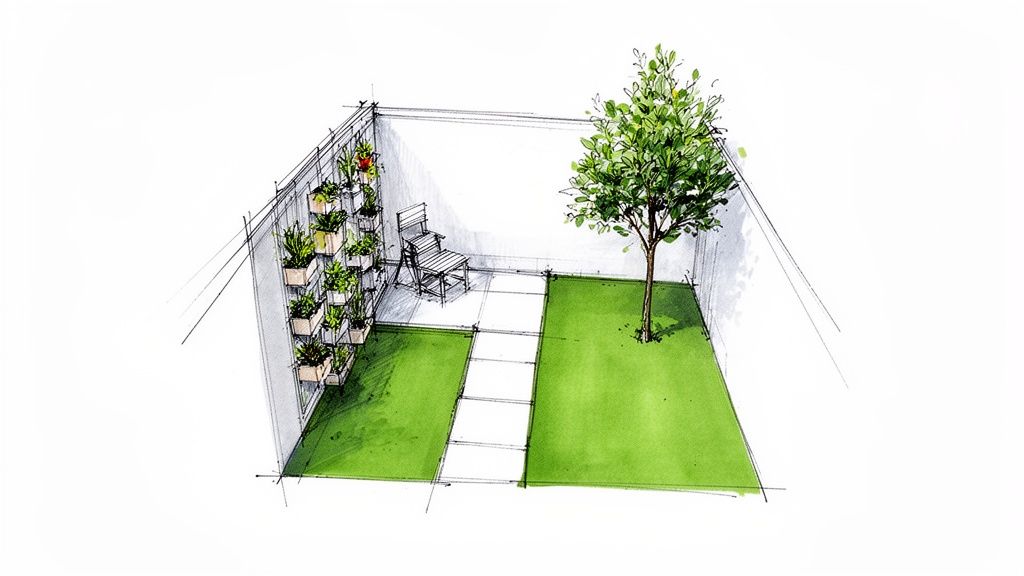
Create functional zones: Even a small area can have a cozy reading nook, a vertical herb garden, or a small patio perfect for morning coffee.
Think vertically: Use trellises, climbing vines, and wall planters to draw the eye upward. This simple trick makes the whole garden feel larger and more dynamic.
Choose multifunctional elements: Look for features that pull double duty, like a raised planter bed that also works as a bench or a decorative screen that provides much-needed privacy.
From Idea to Reality with AI Visualization
For years, the biggest hurdle in any small landscape garden design was trying to picture the final result. It’s tough to know how a new patio, a flowering border, or a privacy screen will really look and feel until all the work is done. This is where modern tech has completely changed the game for homeowners.
The global market for Landscape and Garden Design Software has exploded, signaling a huge shift that makes professional-level design accessible to everyone. You can apply AI Landscape Design to visualize your ideas by simply taking a photo of your own yard. Apps like DreamzAR let you instantly generate custom designs without needing to learn complex software.
The real power comes from visualization. With AI, you can take a photo of your yard and test out countless ideas. See exactly how a stone pathway looks next to your door or how a vertical garden fills an empty wall—all before lifting a single shovel.
This whole process just removes the guesswork and the financial risk, giving you the confidence to move forward with a plan you know you'll love. You can explore a ton of different concepts, from modern minimalist layouts to lush, cottage-style gardens, all tailored to your actual space.
For more inspiration on transforming a limited area, check out our guide on small backyard landscape ideas. This visual-first approach makes getting a professional-quality design more attainable than ever before.
Reading Your Yard Like a Pro
Before you even think about buying a single plant or laying down a paver, the most important thing you can do for your small landscape garden design is to simply get to know your space. Think of it as being a detective on a mission, gathering clues about your own yard. This isn't just busywork; it's the foundation that prevents expensive mistakes and sets your garden up for success year after year, not just for one pretty season.
Great gardens don't just happen. They’re the result of smart planning that starts with a real-world understanding of your property's quirks. Skipping this assessment is like trying to bake a cake without knowing if your oven runs hot or cold—you might get lucky, but you probably won't.
Mapping the Sun and Shade
The biggest boss in your garden is the sun. Its daily journey across your yard dictates everything—what will thrive, what will fry, and where things should go. A spot that’s drenched in lovely morning light can be in deep shade by 3 PM, creating two totally different microclimates in the same small area.
To get a true picture, you've got to map your sun exposure throughout the day. It's easier than it sounds.
Morning Sun: Pop outside around 9 AM. See which areas are getting direct light. This light is usually softer and perfect for a wide range of perennials.
Midday Sun: Check again between 12 PM and 2 PM. This is the blast furnace. Only the toughest, most heat-loving plants are going to be happy here.
Afternoon Shade: Take a final look around 4 PM. Notice where the shadows from your house, the fence, or your neighbor's big oak tree have fallen. These spots offer a cool refuge, ideal for plants like hostas and ferns.
Snap a few photos at each of these times. This visual diary is gold when you start sketching out your layout and making your plant list.
A pro tip I always share: if you have the time, do this once in the summer and once in the winter. The sun's angle is way lower in winter, which means much longer shadows. That "full sun" spot in July might be in shade for most of the day in January.
Getting a Feel for Your Soil
The soil is literally the foundation of your garden. Figuring out its texture—whether it’s heavy clay, sandy, or a nice balanced loam—is non-negotiable for picking plants that will actually grow. A simple "jar test" is a surprisingly effective way to get the dirt on your dirt.
Just grab a clear mason jar, fill it about halfway with soil from your garden bed, add water until it’s almost full, and give it a really good shake. Let it sit for 24 hours. You'll see the soil separate into layers: sand on the bottom, silt in the middle, and clay on top. If the layers are pretty even, congratulations, you have loam! A thick layer of any one tells you what you're up against.
This isn't just an academic exercise. Clay soil holds water (sometimes too well), meaning you'll water less but need good drainage. Sandy soil drains like a sieve, so you'll be watering more often. This info shapes everything.
Bring Your Site Analysis to Life with AI
Juggling all this info—sun maps, soil type, notes about that weird windy corner—can feel like a lot. This is where AI Landscape Design tools like DreamzAR can be a game-changer. Instead of just messy sketches and notes, you can create a living map of your site.
Start by taking a good, clear photo of your yard. Once you upload it to the app, you can visualize your ideas and start layering your findings right onto the image. Imagine digitally "painting" the full-sun zones yellow and the shady spots blue. You can drop virtual pins to mark things like "soggy spot here" or "good view to keep."
This turns your raw data into a dynamic visual blueprint. Later, when you use the AI to brainstorm design ideas, it’s not just guessing; it’s working from the real-world intelligence you gathered. It’s the perfect blend of your hands-on observation with powerful tech, ensuring every design choice is grounded in the reality of your actual yard.
Designing for Flow and Function
In a small garden, every single element has to earn its place. There's simply no room for features that don't serve a purpose or contribute to the overall vibe of the space. This is where we stop just observing the yard and start strategically designing it. The goal is to create a garden that’s not only beautiful but highly functional, making your small yard feel intentional, organized, and much larger than it really is.
A common mistake I see people make with small yards is treating the area as one big, uniform space. Instead, think of it like an outdoor room that can be divided into smaller, distinct zones. This simple shift in thinking creates interest and makes the garden feel way more dynamic and useful.
Creating Zones in a Compact Space
Even the tiniest yard can have multiple functional areas. The secret is to define these zones without putting up actual walls. You can use subtle cues to signal a shift in function, creating dedicated spots for all the things you want to do outside.
Here are a few ideas to get you started:
A cozy conversation nook: Just a couple of chairs and a small table set on a patch of gravel or a tiny paver circle can create an intimate spot for coffee.
A vertical herb garden: Mount some wall planters or a trellis near your kitchen door for a culinary zone that's both practical and beautiful.
A quiet meditation spot: A single comfortable bench tucked into a corner, surrounded by calming plants like lavender, can become your personal retreat.
A central gathering point: A small, circular patio can act as the main "room" for entertaining, with paths branching off to other little nooks.
These zones give your garden a sense of purpose and guide how you and your guests move through it. You can define them with different flooring materials, a small change in elevation, or by grouping specific types of furniture and plants.
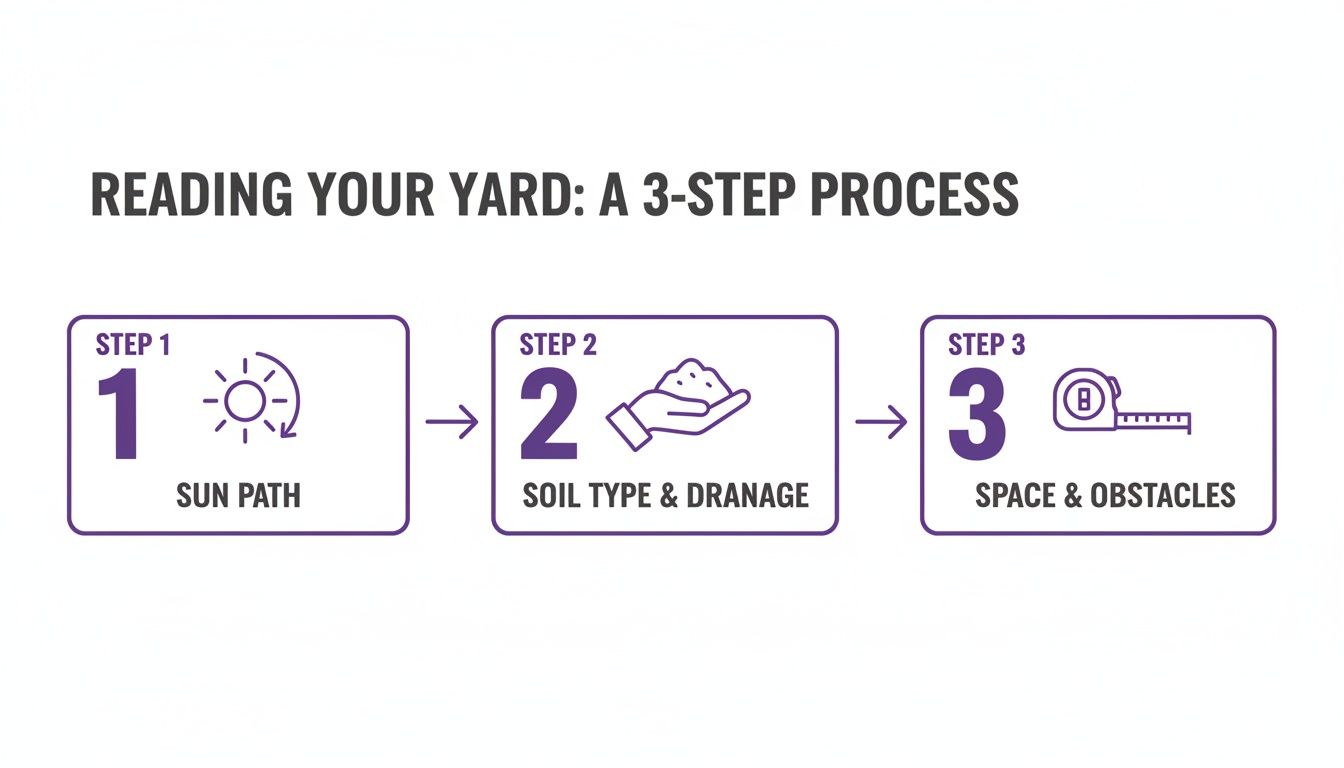
This process chart really nails down the foundational site analysis you need to do before laying out your functional zones. Understanding these core elements—sun, soil, and space—is what lets you put each zone in the perfect spot to thrive.
To help you brainstorm, here's a simple breakdown of how you can think about zoning your small garden.
| Maximizing Small Garden Zones || :--- | :--- | :--- | :--- || Garden Zone | Primary Function | Key Design Elements | Recommended Plant Types || Dining/Entertaining Area | Socializing, eating | Paver patio, outdoor rug, fire pit, ambient lighting | Container plants, ornamental grasses for texture, small flowering trees for a canopy || Relaxation Nook | Reading, quiet time | Comfortable bench or lounge chair, small side table, water feature | Calming plants like lavender and chamomile; fragrant flowers like gardenias || Culinary/Herb Garden | Growing edible plants | Vertical planters, raised beds, pots near the kitchen door | Herbs (rosemary, basil, mint), compact vegetables (lettuce, cherry tomatoes), edible flowers || Play Zone | Children's activities | Soft ground cover (e.g., rubber mulch), durable lawn area, storage for toys | Tough, non-toxic plants; plants that attract butterflies or hummingbirds for sensory engagement |
By thoughtfully planning these zones, even a tiny space can feel versatile and full of possibilities.
Go Vertical to Maximize Your Space
When you can't build out, build up. This is probably the single most effective strategy for making a small garden feel more expansive. Drawing the eye upward creates an illusion of height and depth, which keeps the space from feeling cramped or boxed in.
There are so many ways to incorporate vertical elements:
Trellises and Arbors: These are perfect for supporting climbing plants like clematis or jasmine, giving you a wall of green without eating up precious ground space.
Wall-Mounted Planters: You can instantly create a living wall of succulents, herbs, or flowers on a boring fence or the side of your house.
Tall, Slender Plants: Use columnar trees like Italian Cypress or tall ornamental grasses to add strong vertical lines that punctuate the design.
These vertical features do more than just add visual interest—they can create privacy, block unsightly views, and add beautiful layers to your garden. A well-placed pathway can also guide the eye and enhance the sense of a journey through the space; you can find more inspiration in our guide to walkway and path design.
Don’t just think about what’s on the ground. The vertical plane—your fences, your house walls, the space above your head—is some of the most valuable real estate in a small garden. Using it wisely is what separates a good design from a great one.
Visualize Your Layout with AI Landscape Design
Deciding on the perfect layout is often the hardest part. How big should the patio be? Where should the seating area actually go? Will that water feature feel too crowded in the corner? This is where guesswork can lead to expensive mistakes and a lot of frustration.
This challenge is exactly what AI Landscape Design was made for. Using an app like DreamzAR, you can take a photo of your own yard and visualize countless layout ideas without any commitment. You can virtually place a paver patio, test different seating arrangements, and see how a small water feature looks next to your fence.
The real power is in the Augmented Reality (AR) feature. You can literally stand on your back step and, looking through your phone, see the new layout overlaid onto your actual yard. It lets you walk around the virtual elements, check the flow between zones, and confirm that the scale and proportions feel right before you ever pick up a shovel. It completely removes the uncertainty from the planning process.
Choosing Plants and Materials That Work Harder
Once your zones are mapped out, the real fun begins: filling them with life and texture. The plants and hardscaping materials you choose are the very soul of your small landscape garden design. They’re what will turn a smart layout into your own private outdoor retreat.
In a compact space, every single choice carries more weight. The trick is to pick elements that pull double or even triple duty—think plants that offer beauty across multiple seasons and materials that create a clever illusion of spaciousness.
This focus on hardworking elements isn't just a niche idea; it’s a massive trend. The Landscaping and Gardening Service Market is sitting at a hefty USD 118.51 billion and is expected to climb to USD 160.11 billion by 2030. A huge driver for that growth? Homeowners just like you, looking to maximize small yards to boost curb appeal—a move that can bump up a home's value by 7-15%. You can dig deeper into these numbers in the full industry report.
Selecting Plants with Multi-Season Interest
In a small garden, there’s simply no room for a "one-hit wonder" that looks good for two weeks in May and then fades into the background. Your mission is to curate a collection of plants that ensures there's always something interesting to look at, no matter the time of year. This means looking beyond just a pretty flower.
Think about what a plant can offer through its entire life cycle:
Spring: Of course, you want spring blooms. Look for dwarf flowering shrubs like a 'Bloomerang' Lilac that puts on a great show in spring and then surprises you with another round of flowers later in the summer.
Summer: This is the season for long-lasting color. Perennials like Coneflowers (Echinacea) or Catmint (Nepeta) are workhorses that will keep the color coming for months.
Autumn: Don't neglect fall. Select plants with spectacular autumn foliage, like a Dwarf Fothergilla, which ignites into brilliant shades of orange and red.
Winter: Yes, even winter! The garden doesn't have to be bleak. A Coral Bark Japanese Maple boasts stunning red stems that practically glow against snow, and many ornamental grasses leave behind beautiful seed heads that catch the frost.
The real magic in a small garden is layering these multi-season performers. A plant grouping that combines spring bulbs, summer-blooming perennials, and a shrub with winter interest ensures your garden never has an "off-season."
Using Color and Texture to Create Space
Here’s a pro tip: a disciplined color palette is your best friend for making a small garden feel larger and more peaceful. Instead of a chaotic explosion of every color in the rainbow, try sticking to a more limited scheme. Cool colors—think blues, purples, and soft whites—tend to recede visually, which creates a wonderful sense of depth.
Texture is just as critical. When you combine different leaf shapes and sizes, you add a layer of visual complexity and interest. Try placing the delicate, feathery foliage of a fern next to the big, bold leaves of a Hosta. That contrast alone makes the planting feel so much richer and more thoughtfully designed. Don't be shy about mixing it up.
Smart Hardscaping for Small Yards
Hardscaping—the non-plant stuff like your patio, paths, and walls—is the skeleton of your garden. The materials you pick here can dramatically alter the perception of space.
Here are a few of my go-to strategies for small gardens:
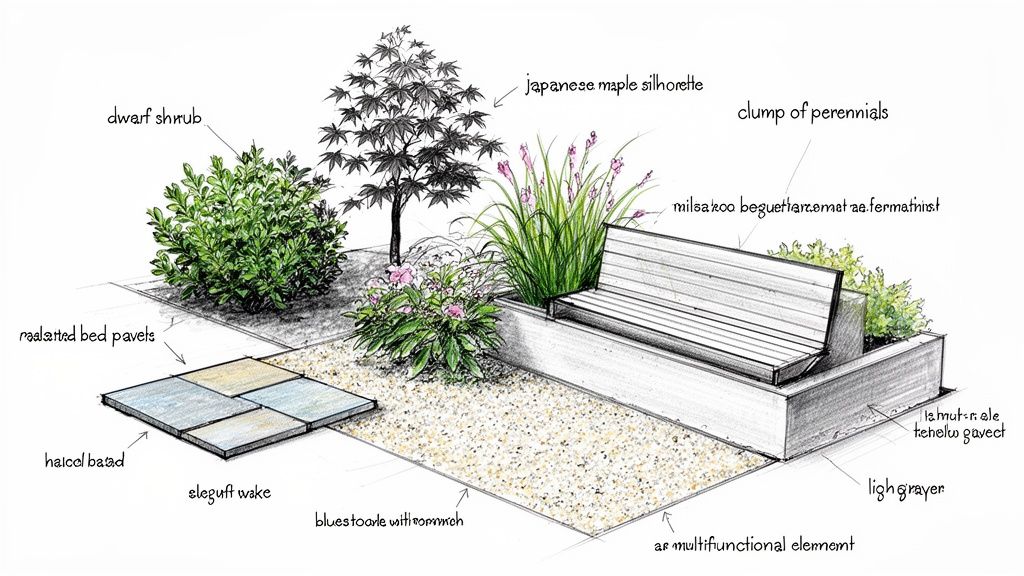
Large-Format Pavers: Using fewer, bigger pavers with tight grout lines gives you a clean, uncluttered surface. It’s a simple trick that makes a patio feel way more expansive than it is.
Light-Colored Materials: Materials like light gray pavers, pale gravel, or travertine are fantastic because they reflect light. This can make a shady or tight corner feel significantly brighter and more open.
Multifunctional Features: Get your hardscape to work for you. A raised planter bed built from stone or wood can be designed with a wide cap that doubles as a built-in bench. You save space, add seating, and get your planting bed all in one move.
Visualize Your Choices with AI Landscape Design
Trying to imagine how all these plants and materials will actually look together can be tough. Will the texture of that Japanese Maple really work with the bluestone patio you’re eyeing? This is where seeing your ideas before you build becomes a game-changer.
This is exactly what an AI Landscape Design tool like DreamzAR is for. It takes the guesswork completely out of the equation. You just upload a photo of your own yard to visualize your ideas. The app has a massive library of real plants and materials you can virtually drop into your space. See how different paver styles look against your house, test out plant combinations, and get a true feel for your choices before you spend a dime. It's the perfect way to make sure the vision in your head translates beautifully to your backyard.
Visualizing Your Dream Garden with AI
This is where the fun really begins—turning those ideas swirling around in your head into something you can actually see. Planning is one thing, but being able to visualize your small landscape garden design before you touch a shovel is a total game-changer. It’s what gives you the confidence to move forward and helps you avoid those “oops” moments that can be so costly.
Luckily, you don’t need to be a landscape architect to do this. The latest tech basically puts a design studio right in your pocket. You can apply AI Landscape Design to visualize your ideas using photos of your own yard, moving past rough sketches into something way more dynamic and interactive. The whole point is to take the guesswork out of the process, so you're absolutely sure about your layout, plants, and materials before the real work starts.
Bringing Your Yard to Life Instantly
It all starts with a simple photo. Seriously, that's it. Just head outside and snap a clear picture of the part of your yard you want to makeover. Think of this photo as your blank canvas.
Once you pop that picture into an AI landscape design app like DreamzAR, things get exciting. The AI looks at everything in your photo—the size of the space, your house, the existing trees, where the sun hits—and starts generating dozens of unique design concepts right on top of it. One minute you’re looking at your plain lawn, and the next you’re seeing it transformed with a sleek modern patio, a lush English cottage garden, or something else you would have never dreamed up on your own.
This isn't about the AI doing all the work for you. It's about giving your own creativity a massive boost. Think of the AI as a design partner that never gets tired, constantly throwing out fresh ideas that you can then tweak, combine, or use as a launchpad for your own vision.
You might see a paver pattern that's perfect for your patio or realize how a small bubbling fountain could become the focal point you were missing.
Walk Through Your New Garden with Augmented Reality
Okay, this is where it feels like magic. Once you’ve landed on a design idea you’re excited about, you can use Augmented Reality (AR) to see it in the real world. The app uses your phone’s camera to overlay the digital design right onto the photo of your own yard.
Instead of just looking at a flat image, you can get up and physically walk through your future garden.
Check the Views: Stand by your kitchen window. Will that new Japanese Maple you’re planning block the view of the kids playing? Now you can see for yourself.
Get a Feel for Scale: Walk around the virtual patio set. Is there actually enough room to pull out the chairs and move around comfortably? Does that fire pit suddenly feel way too big for the spot? You’ll know instantly.
Test the Flow: Pretend you're walking from the deck to the new seating area. Does the path feel natural? Is it wide enough?
This is so much more powerful than just looking at a 2D drawing. You get a real, intuitive sense of the space and its proportions. It’s one thing to see a design on a screen; it’s another to “stand” right in the middle of it. For even more inspiration on layouts and styles, it can also be helpful to explore different free AI home design tools to see what's possible.
Finalizing Your Plan with Total Confidence
Using AI to prototype your garden this way pretty much eliminates landscape buyer's remorse. You can play around with different pavers, swap out plants, and nudge a flower bed over by a few feet—all with zero cost or commitment. You can learn more about the specific AI and AR features that make this possible and see how they can work for your own project.
By the time you’re ready to call a contractor or fill up a cart at the nursery, you won't just have a vague notion of what you want. You’ll have a fully visualized, road-tested plan that you've already walked through from every single angle. That level of certainty is what makes sure your investment of time and money creates a garden you'll absolutely love for years to come.
Creating a Low-Effort, High-Impact Garden
A beautiful garden should be a place to relax, not another item on your weekend to-do list. I’ve always believed that the most successful small landscape garden designs are the ones that thrive with minimal fuss, giving you more time to actually sit back and enjoy them. It really just comes down to making smart, sustainable choices from the get-go.
The secret is to work with your environment, not against it. That journey starts with picking the right plants. I always recommend starting with drought-tolerant native plants that are already perfectly adapted to your local climate. They naturally require less water and are tougher against local pests, which immediately cuts down on your workload.
Another powerful tool in the low-effort arsenal is good old mulch. A thick layer of organic mulch does wonders for retaining soil moisture, meaning you’ll be watering far less often. Even better, it acts as a natural weed barrier. You’ll spend less time pulling up pesky intruders and more time with your feet up. If you're not sure how much you need, a good mulch calculator can be a huge help.
Smart Systems and Budget-Friendly Tips
To truly put your garden's upkeep on autopilot, look into a simple drip irrigation system hooked up to a timer. This method is incredibly efficient, delivering water directly to the plant's roots instead of spraying it everywhere like a sprinkler. It’s a classic set-it-and-forget-it solution that keeps your plants happy and hydrated without you lifting a finger.
You can also make choices that are friendly to both your wallet and your schedule. Starting plants from seed is a fantastic way to save money, and you'd be surprised what you can find at local salvage yards. I've seen people uncover unique, weathered materials for planters or pathways that add instant character without the hefty price tag.
Your biggest time-saver might just be the design itself. Things like expanding your hardscaping for a stylish ‘no-grass’ backyard or using structural evergreens for year-round beauty are amazing low-upkeep strategies that look fantastic.
Visualize Your Low-Maintenance Ideas
Before you commit to buying plants or laying down stone, you can see exactly how these ideas will look in your own yard. This is where tools for AI Landscape Design become so valuable. Just snap a photo of your yard and upload it to an app like DreamzAR to visualize your ideas.
From there, you can virtually test drive a no-grass design with gravel paths, see how a drip irrigation system could be neatly tucked away among native plants, or check out how a few well-placed evergreen shrubs would look in the dead of winter. It’s a fantastic way to make sure your low-effort garden is also a high-impact one, letting you confirm every choice will look great before you even start digging.
Your Small Garden Questions, Answered
When you're just starting a small landscape garden design, it's natural to have a few questions. I see homeowners run into the same hurdles all the time. Let's tackle some of the most common ones so you can move forward with confidence.
How Can I Make My Tiny Garden Feel Bigger?
This is the classic small-space challenge. The secret is to think vertically. You want to draw the eye up so the brain doesn't focus on the limited footprint. Trellises, wall-mounted planters, or slim, tall plants like Italian Cypress do this beautifully.
Another pro tip is to stick with a light, cohesive color palette for your pavers and flowers. Cool tones, like blues and purples, have a receding effect that creates a sense of depth. Laying pavers on a diagonal is another clever trick that can visually widen the space. And whatever you do, avoid clutter—choose one or two bold focal points instead of a bunch of small, scattered decorations.
What Are the Best Low-Maintenance Plants for a Small Yard?
You want a gorgeous garden, not a second job, right? The key is to find hardworking plants that deliver a big impact without demanding constant attention.
I always recommend starting with these:
Dwarf conifers and ornamental grasses (like Blue Fescue) offer amazing texture and color year-round.
Succulents, such as Sedum, are practically bulletproof and require very little water or care.
Hardy perennials like Lavender and Coneflower are fantastic for reliable, long-lasting blooms without all the fuss.
These options give you a beautiful, layered look that won't have you constantly pruning and watering.
Can I Really Design My Garden with an App?
Absolutely. The biggest roadblock for most people isn't a lack of ideas—it's being unable to visualize how those ideas will actually look in their own yard. That’s where technology steps in.
Modern AI Landscape Design apps like DreamzAR were built specifically for homeowners, not just landscape architects. You can snap a photo of your yard and instantly visualize different plants, pavers, and layouts. It completely removes the guesswork. You get to see a realistic preview of your plan and fall in love with it before you ever pick up a shovel.
For more answers to common queries, you can explore our full FAQ section.
Ready to stop guessing and start visualizing? With DreamzAR, your perfect small garden is just one photo away. Download the app and generate unlimited professional designs tailored to your exact yard in seconds. See your dream space come to life at https://www.dreamzar.app.