Plants Low Maintenance Garden: Easy, Stunning Ideas
Imagine a beautiful, thriving garden that requires less watering, weeding, and fussing. This isn't a fantasy; it’s the reality of a well-planned low-maintenance landscape. In a world where time is a precious asset, creating an outdoor space that provides joy without demanding constant labor is the ultimate goal. The secret lies in choosing the right plants: resilient, self-sufficient species that offer maximum beauty for minimal effort. These selections are not only tough but also visually stunning, ensuring your yard looks vibrant through the seasons.
This guide moves beyond generic advice. We'll explore ten categories of powerhouse plants perfect for a low-maintenance garden, from vibrant ornamental grasses to hardy evergreen shrubs. You'll get specific care notes, practical planting tips, and landscape pairing ideas for each. To truly minimize effort in your garden, consider implementing outdoor automatic watering systems, which can simplify care for container and patio plants without constant supervision.
But how do you know which plants will work in your specific yard? This is where modern technology transforms the process. You can apply AI Landscape Design to visualize your ideas using photos of your own yard. An AI tool can take a picture you've taken and instantly show you how these hardy plants will look, mature, and interact with your home's unique features. Forget guesswork. This list will show you how to confidently design your dream outdoor space before ever breaking ground.
1. Ornamental Grasses (Fountain Grass, Blue Fescue)
Ornamental grasses are a cornerstone for any plants low maintenance garden, offering unparalleled texture, movement, and year-round visual interest. These hardy perennials, such as the graceful Fountain Grass (Pennisetum setaceum) and the striking Blue Fescue (Festuca glauca), are celebrated for their drought tolerance and ability to thrive in a variety of soil types with minimal intervention. Once established, they require little more than an annual trim, making them a top choice for gardeners seeking beauty without the burden of constant care.
Their architectural forms create a modern, dynamic aesthetic. Imagine a cluster of tall Feather Reed Grass (Calamagrostis) forming a soft privacy screen along a property line, or the silvery-blue mounds of Blue Fescue contrasting beautifully against dark mulch in a rock garden. These grasses are not just fillers; they are statement pieces that bring a landscape to life with their gentle swaying in the breeze.
Quick Implementation Guide
Planting: Plant new grasses in the spring to give them a full growing season to establish strong root systems before winter.
Grouping: For maximum visual impact, plant in odd-numbered groups (3, 5, or 7). This creates a more natural and cohesive look than single specimens.
Annual Maintenance: The primary task is a single haircut. Cut the grasses back to a few inches above the ground in late winter or early spring, just before new shoots emerge.
Pairing: Combine with flowering perennials like Coneflower or Sedum. The grasses provide a soft backdrop for the flowers in summer and offer structural interest after the blooms have faded.
AI Design Tip: Visualizing the subtle movement and texture of ornamental grasses can be challenging. You can apply AI Landscape Design by uploading a photo of your own yard to see how different grass varieties will look. An app like DreamzAR can place digital models directly into your photo, helping you see how they will capture the light and move with the wind, ensuring you select the perfect type for your space.
2. Sedums and Succulents (Stonecrop, Jade Plant)
Sedums and succulents are the undisputed champions of the plants low maintenance garden, defined by their fleshy, water-storing leaves that make them incredibly drought-tolerant. Varieties like the ground-hugging Stonecrop (Sedum) and the classic Jade Plant (Crassula ovata) thrive on neglect, requiring minimal watering, no fertilizing, and little to no pruning. Once established, they offer a stunning variety of forms, colors, and textures, making them a perfect solution for gardeners wanting a visually striking landscape without the demanding upkeep.
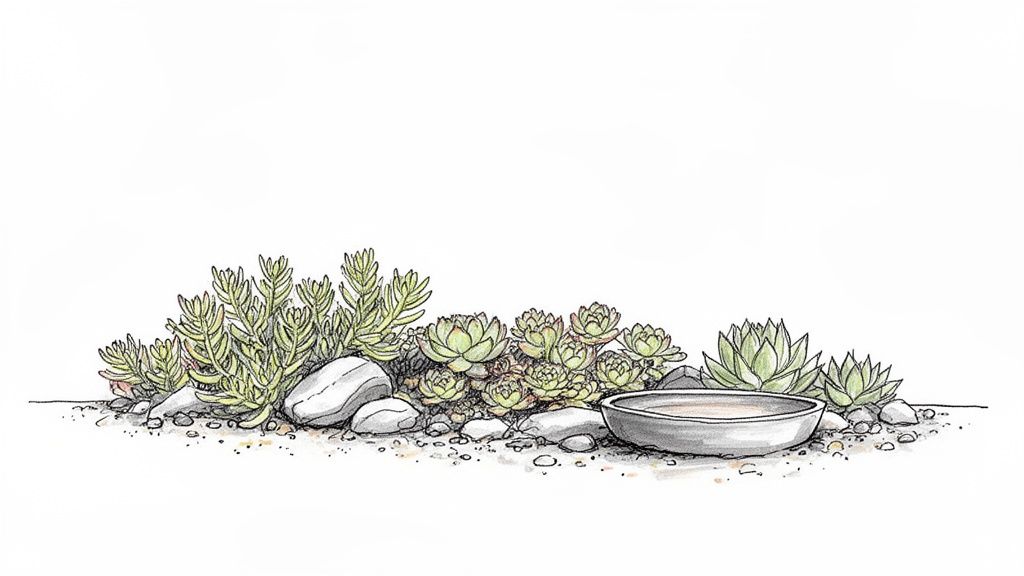
Their versatility allows for creative and water-wise designs. Consider a front yard rock garden in a dry climate where mixed sedum plantings create a living carpet of greens, reds, and blues, drastically reducing water usage. They are also ideal for modern patio designs, where arrangements in containers replace traditional, thirsty annuals. For more inspiration, explore these succulent garden ideas to see how effectively they blend beauty with sustainability.
Quick Implementation Guide
Planting: Ensure you plant in well-draining, sandy, or gritty soil. Poor drainage is the fastest way to harm succulents. Amend heavy clay soils with sand or gravel.
Watering: Water deeply but very infrequently. Allow the soil to dry out completely between waterings, typically once a month in summer and even less in winter.
Annual Maintenance: The primary task is simply to remove any dead or dried leaves. Overcrowded plants can be easily divided and replanted every 2-3 years to expand your collection.
Pairing: Combine different succulent varieties to create a tapestry of color and texture. Enhance the look with decorative rocks, gravel, or dark mulch, which helps showcase their unique forms.
AI Design Tip: Succulents offer endless arrangement possibilities. Apply AI Landscape Design to visualize your ideas by uploading photos of your own yard. You can virtually place different succulent containers on your patio or design a complete rock garden. An app like DreamzAR lets you preview combinations of succulents with various mulches and rocks, ensuring your design is perfect before you buy a single plant.
3. Hydrangeas (Panicle and Oakleaf Varieties)
Hydrangeas are iconic shrubs, but not all are created equal for a plants low maintenance garden. Panicle (Hydrangea paniculata) and Oakleaf (Hydrangea quercifolia) varieties are the workhorses of the family, offering spectacular blooms without the fuss associated with their mophead cousins. These hardy types are more forgiving of soil pH, more cold-hardy, and require significantly less pruning, thriving with minimal intervention once established. They are a perfect choice for gardeners who desire dramatic floral displays without demanding upkeep.
From the large, cone-shaped flowers of panicle hydrangeas in a New England cottage design to the unique, peeling bark and rich fall color of oakleaf hydrangeas in a modern farmhouse landscape, these shrubs provide multi-season interest. They act as stunning focal points or create lush, informal hedges. Their dried flower heads can be left on the plant to provide beautiful structural form throughout the winter months, adding character to the quiet garden.
Quick Implementation Guide
Planting: Settle new plants in the ground during the cooler, moister months of spring or fall to ensure a strong root system develops before the stress of summer heat.
Location: While tolerant, they perform best with morning sun and afternoon shade. Mulching around the base is key to retaining soil moisture and protecting roots.
Annual Maintenance: The primary task is a simple pruning in late winter or early spring. Panicle hydrangeas bloom on new wood, so you can cut them back to encourage vigorous new growth and abundant flowers.
Pairing: Combine with shade-loving perennials like Hostas and Ferns, or contrast their broad leaves with the fine texture of ornamental grasses for a dynamic border.
AI Design Tip: Hydrangeas change dramatically in size and shape from planting to maturity. Apply AI Landscape Design by using a photo of your own yard to visualize how different panicle or oakleaf varieties will look. This allows you to see their full, mature size and ensures they won't overwhelm a space, helping you perfect placement and spacing from the start.
4. Russian Sage (Perovskia Atriplicifolia)
Russian Sage is a standout performer in any plants low maintenance garden, offering a stunning cloud of lavender-blue flowers and silvery-green, aromatic foliage. This semi-woody perennial is exceptionally drought-tolerant, deer-resistant, and thrives on neglect, preferring poor soil and full sun. Once established, Perovskia atriplicifolia asks for very little, rewarding the hands-off gardener with months of vibrant color and a robust structure that provides interest even into the winter.
Its airy, upright habit adds vertical dimension without overwhelming the space, making it a versatile choice for various garden styles. Imagine it creating a soft, hazy backdrop in a Mediterranean-style garden in California, or weaving through a drought-resistant perennial border in a Southwest design. Its fine texture contrasts beautifully with bold-leaved plants, and its ability to attract pollinators like bees and butterflies adds ecological value to its low-care profile.
Quick Implementation Guide
Planting: Choose a location with at least six hours of direct sunlight per day. Avoid overly rich or consistently damp soil, which can lead to weak, floppy growth.
Grouping: For a full, cohesive drift of color, space plants approximately 2-3 feet apart. This allows them to grow into a seamless, interconnected mass.
Annual Maintenance: The only essential task is a hard prune in early spring. Cut the woody stems back to about 6-12 inches from the ground just as new growth begins to emerge.
Pairing: Combine with other sun-loving, drought-tolerant perennials like Black-Eyed Susan, Coneflower, or Sedum 'Autumn Joy' for a resilient and beautiful garden combination.
AI Design Tip: Russian Sage's mature size and see-through quality can be tricky to plan for. Apply AI Landscape Design to visualize your ideas using a photo of your own yard. An app like DreamzAR can virtually place several Russian Sage plants, letting you see their full height and spacing to ensure you achieve that perfect dreamy, lavender haze without overcrowding your beds.
5. Coneflowers (Echinacea)
Coneflowers are a quintessential element of any vibrant plants low maintenance garden, celebrated for their daisy-like petals and prominent, spiky central cones. These hardy perennials, including the popular Echinacea purpurea, are exceptionally drought-tolerant, deer-resistant, and unfussy about soil, thriving with minimal attention once established. Their ability to bloom profusely from mid-summer until frost provides long-lasting color while requiring almost no intervention, securing their place as a low-maintenance superstar.
Beyond their resilience, coneflowers serve as ecological powerhouses, attracting a flurry of pollinators like bees and butterflies to the garden. Their sturdy stems and distinctive seed heads provide crucial winter interest and a food source for birds like goldfinches. Whether featured in a Midwestern prairie-style landscape or a suburban pollinator garden, their bold structure and rich colors make a powerful statement without demanding constant care.
Quick Implementation Guide
Planting: For best results, plant in a location that receives at least six hours of direct sunlight daily. Space them 18-24 inches apart to allow for mature growth and good air circulation.
Watering: Water deeply but infrequently during their first year to establish strong roots. Once mature, they are highly drought-tolerant and rarely need supplemental watering.
Annual Maintenance: The primary task is deciding whether to leave the seed heads for winter interest and wildlife. If you do, simply cut the dead stems back to the ground in early spring as new growth appears.
Pairing: Coneflowers look stunning planted alongside ornamental grasses, Black-Eyed Susans, and Russian Sage. Their upright form provides a beautiful contrast to softer, more fluid plant shapes.
AI Design Tip: Coneflowers come in a surprising array of colors, from traditional purple to white, yellow, and orange. You can apply AI Landscape Design by using a photo of your own yard to experiment with different color combinations. This allows you to visualize how various Echinacea cultivars will complement your existing plants before you buy.
6. Hostas (Shade-Tolerant Foliage Plants)
Hostas are the undisputed champions of the shade garden and a vital component of any plants low maintenance garden plan. Prized for their stunning foliage, which comes in a vast array of greens, blues, golds, and variegated patterns, these perennials thrive in spots where other plants fail. Their resilience and ability to flourish with minimal fuss make them an essential choice for gardeners looking to create lush, vibrant landscapes in partially or fully shaded areas without constant upkeep.
These foliage-forward plants are perfect for adding texture and color under mature trees or along the north-facing side of a home. Imagine the large, chartreuse leaves of 'Sum and Substance' creating a bold statement in a dark corner, or the cool, blue-toned leaves of 'Halcyon' forming a serene groundcover in a woodland-inspired setting. Hostas grow into dense, weed-suppressing clumps, drastically reducing the need for weeding and watering once established.
Quick Implementation Guide
Planting: Plant hostas in the spring or early fall to allow their root systems to establish before extreme temperatures set in.
Siting: Choose varieties based on your specific light conditions. Blue-leaved hostas perform best in deeper shade, while gold and variegated types often develop more vibrant colors with some morning sun.
Maintenance: Their primary needs are consistent moisture and protection from pests like slugs and deer. Divide overgrown clumps every 5-7 years in the spring to rejuvenate the plants and create new ones.
Pairing: Combine with other shade-lovers like Ferns, Astilbe, and Heuchera. The contrasting textures create a dynamic and visually interesting understory planting that requires very little intervention.
AI Design Tip: Selecting the right hosta variety is key, as their mature sizes can range from a few inches to several feet wide. Apply AI Landscape Design to visualize different hosta types by uploading a photo of your own yard's shaded areas. This helps you see their mature size and foliage color against your home's foundation or existing trees, ensuring you achieve a perfectly layered, low-maintenance design.
7. Junipers (Columnar, Spreading, and Dwarf Varieties)
Junipers are the ultimate workhorses for a plants low maintenance garden, offering unmatched resilience and evergreen structure throughout the year. These tough conifers, available in a vast array of forms like the slender 'Skyrocket' (columnar), ground-hugging Blue Rug (Juniperus horizontalis), and compact dwarf varieties, are celebrated for their ability to withstand drought, poor soil, and extreme temperatures. Once established, they demand virtually no care, making them foundational elements for any garden designed for simplicity and lasting beauty.
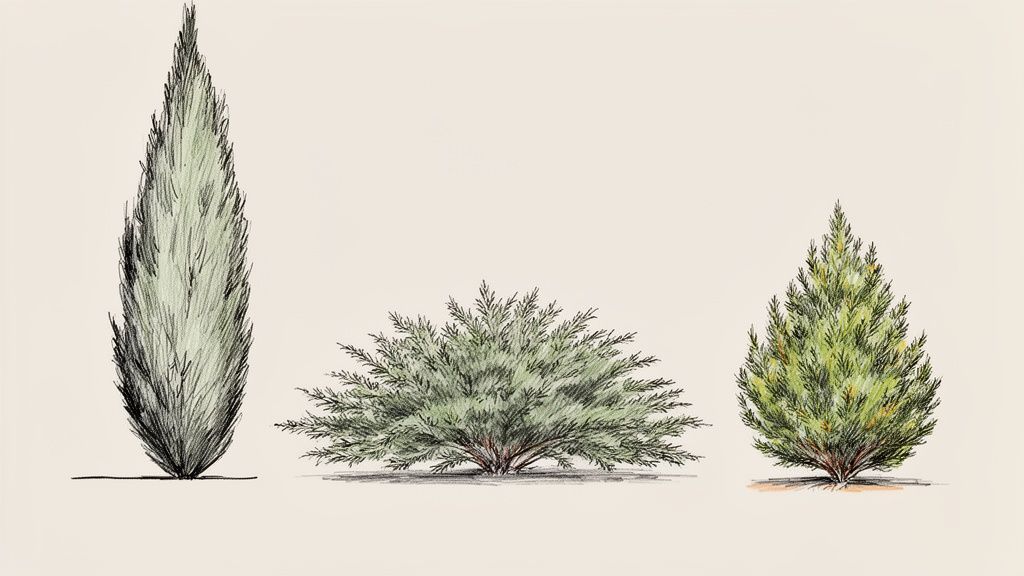
Their diverse shapes and textures provide endless design possibilities. Imagine the sharp, vertical lines of columnar junipers creating a formal privacy screen, or the soft, silvery-blue carpet of a spreading variety stabilizing a slope and suppressing weeds. From modern xeriscapes to providing year-round foundation plantings that boost curb appeal, junipers deliver consistent color and form without the fuss. Their hardy nature ensures your landscape looks structured and green even in the depths of winter.
Quick Implementation Guide
Planting: Plant in spring or fall in a location that receives at least six hours of full sun. Ensure the soil is well-draining, as junipers dislike "wet feet."
Grouping: Use columnar varieties as vertical accents, spreading types as groundcover, and dwarf mounds in rock gardens or borders for textural contrast.
Annual Maintenance: Junipers are incredibly low-maintenance and rarely require pruning. If needed, a light trim can be done after the initial spring growth flush, but avoid cutting back into old, bare wood.
Pairing: Combine with ornamental grasses like Blue Fescue and perennials such as Sedum or Russian Sage. The fine texture and contrasting colors create a dynamic, water-wise plant community.
AI Design Tip: Selecting the right juniper is crucial, as their mature size varies dramatically. Apply AI Landscape Design to visualize different varieties in your space by taking a photo of your yard. This allows you to see how a tall 'Skyrocket' will look against your house or how a 'Blue Rug' will spread across your garden bed at full maturity, preventing future overcrowding.
8. Butterfly Bush (Buddleia)
The Butterfly Bush is a dynamic addition to any plants low maintenance garden, prized for its rapid growth and spectacular, honey-scented flower spikes that are magnets for pollinators. This deciduous shrub, known scientifically as Buddleia, establishes quickly and delivers high-impact color from summer through fall with very little fuss. Its resilience and fast-growing nature make it a perfect choice for gardeners who want mature-looking landscapes without years of waiting, all while supporting local butterfly populations.
Beyond its pollinator appeal, the Butterfly Bush serves as a robust structural plant. It can quickly fill an empty corner, create a vibrant backdrop for shorter perennials, or serve as a fragrant, informal hedge. Despite its vigorous growth, it is exceptionally drought-tolerant once established and thrives in the full sun locations that many other shrubs find challenging, asking for little more than a single annual pruning to perform its best.
Quick Implementation Guide
Planting: Choose a location with at least six hours of direct sun and well-draining soil. Plant in spring or fall to allow roots to establish.
Annual Maintenance: The key to a healthy plant is a hard prune. In early spring, just as new growth begins to appear, cut all stems back to about 12-18 inches from the ground.
Encouraging Blooms: While not required, deadheading spent flower spikes will encourage the plant to produce a continuous flush of new blooms throughout the season.
Regional Note: Check local regulations before planting, as some Buddleia davidii varieties can be invasive in certain regions like the Pacific Northwest. Look for sterile, non-invasive cultivars.
AI Design Tip: The fast growth of a Butterfly Bush can be hard to picture. Apply AI Landscape Design to see a mature-sized digital model of a Buddleia right in your own yard using just a photo. This helps you visualize its final height and spread, ensuring you give it enough space and can perfectly pair it with complementary plants like Coneflowers for a beautiful pollinator garden design.
9. Mulch and Ground Covers (Creeping Thyme, Sedum, Liriope)
Replacing turf with mulch and ground covers is a foundational strategy for a plants low maintenance garden, dramatically reducing the need for mowing, watering, and fertilizing. Resilient ground covers like Creeping Thyme (Thymus serpyllum), various Sedums, and Liriope (Liriope muscari) create a living carpet that suppresses weeds and retains soil moisture. This approach swaps high-effort lawn care for a diverse, textured, and ecologically beneficial landscape.
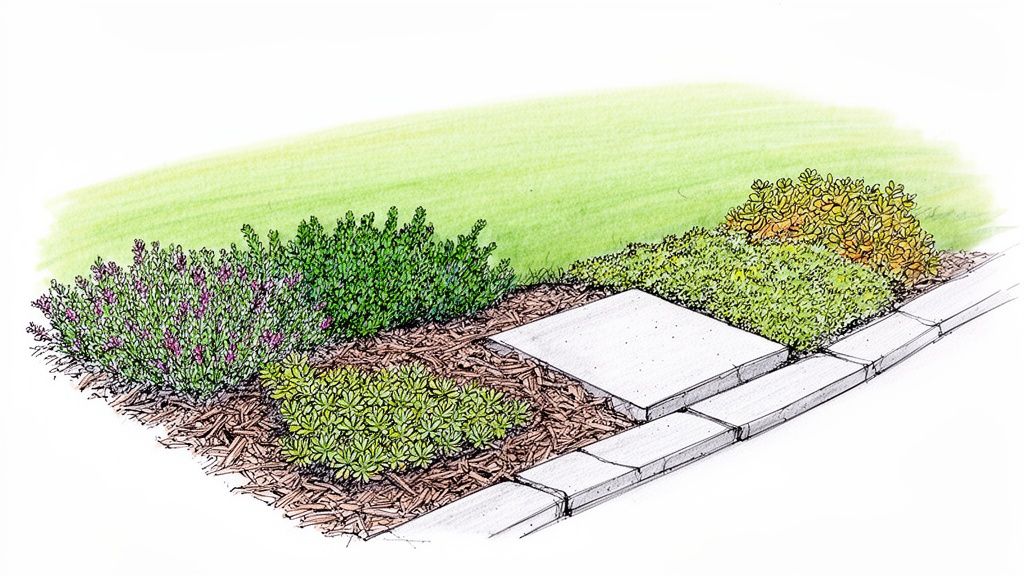
The combination of decorative mulch and hardy ground covers offers endless design possibilities. Imagine a modern xeriscape where swathes of dark bark mulch contrast with vibrant green Sedum, or a Mediterranean-style yard where decomposed granite paths meander through fragrant Creeping Thyme. These combinations are not just functional; they establish a powerful aesthetic that is both beautiful and sustainable, saving water and time.
Quick Implementation Guide
Mulch Application: Apply an initial 3 to 4-inch layer of organic mulch to effectively block sunlight from reaching weed seeds and to retain soil moisture. Use a mulch calculator to determine the exact amount you'll need.
Weed Barrier: For maximum weed suppression in non-planted areas, install landscape fabric before adding your chosen mulch.
Plant Selection: Choose ground covers that are well-suited to your area's specific light and soil conditions. Liriope tolerates shade, while Sedum and Thyme thrive in full sun.
Annual Upkeep: Refresh organic mulch annually or biennially to maintain its depth and effectiveness. Ground covers may need occasional trimming to keep them within their designated boundaries.
AI Design Tip: Deciding between mulch types and ground cover varieties can be difficult. You can apply AI Landscape Design by experimenting with different materials virtually. Simply upload a photo of your yard, and a tool like DreamzAR can show you over 50 different mulch types and ground covers, allowing you to preview textures and colors to ensure your design is cohesive before you start digging.
10. Evergreen Shrubs (Boxwood, Privet, Yew)
Evergreen shrubs are the foundational pillars of a plants low maintenance garden, providing essential structure, year-round color, and privacy with minimal effort. Hardy choices like Boxwood (Buxus), Privet (Ligustrum), and Yew (Taxus) are valued for their resilience, ability to adapt to various soil conditions, and tolerance for pruning. Once they are established, these woody workhorses demand very little water or care, making them perfect for creating a lush, green framework that looks great in every season.
Their versatility allows them to serve multiple functions in landscape design. Picture a classic New England cottage garden framed by neat Boxwood hedging, or a modern home softened with compact Yew foundation plantings. They excel at creating living fences for privacy in suburban yards and can be shaped into formal topiaries for a touch of elegance. Their steadfast presence ensures your garden never looks bare, even in the depths of winter.
Quick Implementation Guide
Planting: Plant in the spring or fall to allow roots to establish before the stress of summer heat or winter cold. Proper spacing is key; check the plant tag for its mature width.
Variety Selection: For the lowest maintenance, choose slow-growing or dwarf varieties that won't require constant pruning to stay in scale with your space.
Initial Care: Mulch around the base after planting to retain soil moisture and regulate temperature. Water regularly during the first year to encourage a deep, strong root system.
Pruning: A light, infrequent shearing is all that's needed to maintain shape. It's better to prune lightly a couple of times a year than to perform one drastic cut. Check your plant's hardiness zone to ensure it's suitable for your climate. For more details, you can check your plant hardiness zone to make the best selection.
AI Design Tip: Evergreen shrubs define the "bones" of a garden, but visualizing their mature size and shape is crucial. Apply AI Landscape Design to place virtual Boxwoods, Yews, or other evergreens into a photo of your own property. This lets you test different arrangements for hedging or foundation plantings, ensuring you get the scale and placement perfect before you dig.
10 Low-Maintenance Garden Plants Comparison
Plant / Element | Implementation Complexity 🔄 | Resource Needs & Maintenance ⚡ | Expected Outcomes & Impact 📊 | Ideal Use Cases 💡 | Key Advantages ⭐ |
|---|---|---|---|---|---|
Ornamental Grasses (Fountain Grass, Blue Fescue) | Low — simple planting, annual cutback 🔄 | Low — drought-tolerant, little fertilizer ⚡ | High visual movement & texture; year-round interest 📊 | Low‑maintenance front/backyards, slopes, erosion control 💡 | Cost‑effective, water savings, pollinator‑friendly ⭐ |
Sedums & Succulents (Stonecrop, Jade Plant) | Very low — easy to plant, minimal care 🔄 | Very low — needs very well‑draining soil; infrequent watering ⚡ | Strong drought‑savings; compact, long‑lasting displays 📊 | Rock gardens, containers, green roofs, small yards 💡 | Exceptional water savings, versatile placement, low cost ⭐ |
Hydrangeas (Panicle & Oakleaf) | Moderate — seasonal pruning for shape 🔄 | Moderate — establish slowly; mulch and occasional watering ⚡ | Long bloom season, architectural form, winter seed interest 📊 | Cottage/modern borders, focal shrubs, cut‑flower gardens 💡 | Showy blooms, cold‑hardy varieties, attractive year‑round form ⭐ |
Russian Sage (Perovskia) | Low — straightforward planting, spring cutback 🔄 | Very low — thrives in poor, dry soil; minimal feeding ⚡ | Extended summer–fall blooms and tall vertical texture 📊 | Mediterranean/xeriscape borders, pollinator beds, narrow beds 💡 | Drought‑proof, pollinator‑attractive, low‑care continuous blooms ⭐ |
Coneflowers (Echinacea) | Low — direct sow or transplant; occasional division 🔄 | Low — deep‑rooted, drought‑tolerant after establishment ⚡ | Long flowering, wildlife value; winter seedheads for birds 📊 | Prairie/pollinator gardens, mass plantings, cut‑flower beds 💡 | Affordable, resilient, attracts pollinators and wildlife ⭐ |
Hostas (Shade‑tolerant foliage) | Low — plant/divide in spring or fall; occasional dividing 🔄 | Moderate — prefer consistent moisture; slug/deer control ⚡ | Strong foliage impact in shade; long‑lived groundcover effect 📊 | Shaded understories, foundation plantings, woodland gardens 💡 | Diverse foliage palettes, solves shady site challenges, durable ⭐ |
Junipers (columnar/spreading/dwarf) | Low — plant to mature size; minimal pruning 🔄 | Very low — drought/poor soil tolerant; little feeding ⚡ | Year‑round evergreen structure and long‑term anchoring 📊 | Windbreaks, foundation plantings, xeriscapes, privacy screens 💡 | Evergreen continuity, extreme hardiness, very low upkeep ⭐ |
Butterfly Bush (Buddleia) | Moderate — fast growth needs annual hard pruning 🔄 | Low after establishment; water during first year ⚡ | Rapid floral display; strong pollinator attraction; fast maturity 📊 | Pollinator borders, quick‑impact landscapes, larger yards 💡 | Fast to flower, abundant blooms, inexpensive to establish ⭐ |
Mulch & Ground Covers (Creeping Thyme, Sedum, Liriope) | Moderate upfront — installation and fabric; low after 🔄 | Low — reduced watering; mulch replenishment annually ⚡ | Suppresses weeds, reduces mowing, large water/time savings 📊 | Lawn replacements, pathways, low‑traffic beds, xeriscapes 💡 | Cuts mowing/watering time, improves soil, versatile aesthetics ⭐ |
Evergreen Shrubs (Boxwood, Privet, Yew) | Moderate — planting + occasional shaping/pruning 🔄 | Low once established; initial mulching and watering ⚡ | Year‑round privacy, structure, formal or informal form 📊 | Privacy hedges, foundation plantings, formal gardens 💡 | Long‑lived structure, privacy/screening, adaptable to styles ⭐ |
Bring Your Low-Maintenance Garden to Life with AI
Creating a vibrant, beautiful garden doesn't have to be a demanding, time-consuming endeavor. As we've explored, the key to a sustainable and enjoyable outdoor space lies in strategic plant selection. By choosing from our curated list of resilient and self-sufficient plants, you’ve taken the most important step toward designing a landscape that thrives with minimal intervention. From the architectural elegance of Ornamental Grasses to the year-round structure of Junipers and Boxwoods, each plant offers a unique blend of beauty and practicality.
The true art of crafting a plants low maintenance garden is not just about individual selections but how they come together. It's about combining textures, colors, and forms to create a cohesive and visually stunning environment that reflects your personal style while respecting your time. The synergy between drought-tolerant Sedums and the airy wands of Russian Sage, or the lush foliage of Hostas under the canopy of an Oakleaf Hydrangea, is where your garden transforms from a collection of plants into a living masterpiece.
From Inspiration to Implementation
The most significant takeaway is that a low-maintenance garden is an achievable goal, built on a foundation of smart choices. Remember these core principles as you begin your project:
Right Plant, Right Place: Match your plant choices to your specific site conditions. Assess your sun exposure, soil type, and climate zone before purchasing. A sun-loving Coneflower will not flourish in deep shade, and a moisture-loving Hosta will struggle in a dry, sun-baked patch.
Group by Needs: Plant species with similar water and light requirements together. This simplifies your care routine, allowing you to water entire zones efficiently rather than tending to individual plants with different needs.
Embrace Mulch and Groundcovers: A thick layer of mulch or a living carpet of Creeping Thyme or Liriope is your best defense against weeds and moisture loss, drastically cutting down on your two biggest maintenance tasks.
Visualize Your Success Before You Plant
The final, and perhaps most exciting, step is moving from a list on a page to a tangible vision for your yard. This is where you can apply AI Landscape Design to visualize your ideas using photos of your own yard, eliminating costly mistakes and uncertainty. Instead of trying to imagine how a mature Blue Fescue will look next to your walkway or whether a row of Butterfly Bushes will fit along your fence, you can see it with perfect clarity.
Using a tool like DreamzAR AI Landscape Design allows you to bridge the gap between idea and reality. Simply upload a photo of your own yard, and the AI can generate realistic designs incorporating the exact plants discussed in this article. You can experiment with different layouts, test plant pairings, and visualize the long-term impact of your choices without lifting a shovel. This powerful tool empowers you to design with confidence, ensuring the plants low maintenance garden you create is the one you've always dreamed of.
Ready to stop guessing and start designing? Upload a photo of your yard to DreamzAR AI Landscape Design and see how these resilient plants can transform your space. Get instant, customized landscape ideas and bring your beautiful, low-maintenance garden to life today at DreamzAR AI Landscape Design.