10 Best Drought Tolerant Plants for Front Yard Landscapes in 2025
- Dec 31, 2025
- 21 min read
Creating a stunning front yard that turns heads doesn't have to mean high water bills and endless weekend maintenance. The secret lies in choosing the right plants built to thrive, not just survive, in drier conditions. This guide is your ultimate roundup of the best drought tolerant plants for front yard landscapes, designed to deliver maximum beauty with minimal water and effort.
We will dive into a curated list of incredible plants, from dramatic succulents and ornamental grasses to vibrant flowering shrubs and small trees. We won't just list them; we'll provide a complete blueprint for success. For each plant, you'll get essential details on USDA hardiness zones, sun and soil needs, mature size, and actionable low-water maintenance tips. This ensures you can select the perfect options for your specific environment.
A crucial part of any landscape project is visualization. Throughout this article, we'll discuss how you can apply AI Landscape Design to visualize your ideas using photos of your own yard. With tools like the DreamzAR app, you can upload photos and instantly see how these plants will look, removing the guesswork and allowing you to design with confidence before you even pick up a shovel. This is the same technology professionals use to create and share stunning concepts with their clients. For professionals specializing in water-wise landscaping, effectively showcasing their work by creating an online portfolio is an invaluable tool to inspire potential clients and enhance curb appeal.
Get ready to rethink your landscape and unlock the potential of a beautiful, resilient, and effortlessly chic front yard.
1. Agave (Agave americana & Agave parryi)
For homeowners seeking a bold, architectural statement with minimal water needs, Agave is an unrivaled choice among drought tolerant plants for a front yard. These succulents boast dramatic rosettes of thick, fleshy leaves that store water, allowing them to withstand prolonged dry spells and intense heat with remarkable resilience. Their sculptural form creates a powerful focal point, ideal for modern, desert-inspired, or Mediterranean landscape designs.
Agaves are exceptionally low-maintenance once established. They thrive in full sun and demand well-draining soil, making them perfect for rocky slopes, gravel gardens, or raised planters where water runs off quickly. After their first year, they require very little supplemental watering, often only during the most extreme summer heat waves. This resilience makes them a cornerstone of sustainable xeriscaping.
Ideal Applications and Design Pairings
Agave’s striking silhouette is particularly effective in contemporary xeriscapes across Southern California and modern architectural landscapes in Las Vegas. They serve as living sculptures, anchoring garden beds or standing alone as specimen plants.
Complementary Plants: Pair them with softer-textured companions like ornamental grasses (e.g., Blue Fescue) or vibrant perennials like Red Yucca and Salvia to create a dynamic, multi-layered design.
Focal Points: Use a large Century Plant (Agave americana) near an entryway or a cluster of smaller Parry’s Agaves (Agave parryi) in a rock garden to create visual interest.
Mulch Choice: Surround Agaves with inorganic mulch like decomposed granite or river rock to enhance drainage and prevent root rot, which can occur with organic mulches that retain moisture.
Actionable Tips for Success
To ensure your Agave makes a stunning and healthy addition to your landscape, follow these key tips:
Strategic Placement: Plant Agaves away from high-traffic walkways or play areas due to their sharp leaf tips. Proper placement is crucial for safety and aesthetics.
Planting in Groups: For maximum visual impact, arrange them in odd-numbered groups (3 or 5) of varying sizes. This creates a more natural and balanced look.
Visualize Before Planting: The mature size of an Agave can be substantial. You can apply AI Landscape Design to visualize your ideas using photos of your own yard. An app like DreamzAR can show you how different Agave species will look when fully grown, helping you perfect placement and spacing before you even start digging.
Planning a full xeriscape project? You can learn more about how technology can streamline the process by exploring our guide on AI-assisted xeriscape planning.
2. Russian Sage (Perovskia atriplicifolia)
For those seeking airy texture and long-lasting color, Russian Sage is a superb choice among drought tolerant plants for a front yard. This herbaceous perennial offers a delicate, cloud-like appearance with its feathery, silver-green foliage and spires of tiny violet-blue flowers that bloom from mid-summer through fall. Its aromatic leaves release a pleasant scent when brushed, adding a sensory dimension to the garden while its rugged nature allows it to thrive in hot, dry conditions with minimal care.
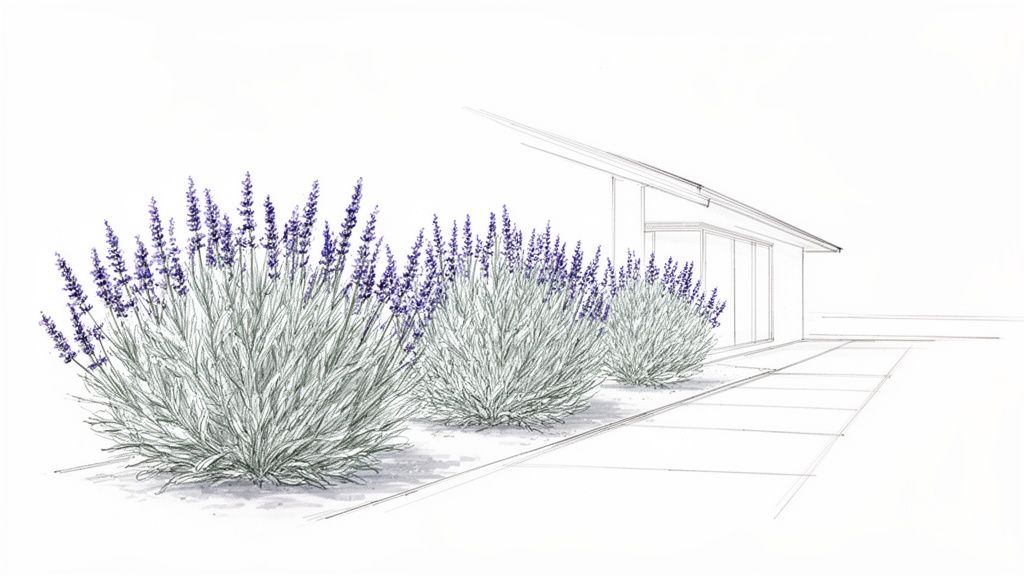
Once established, Russian Sage is exceptionally self-sufficient. It flourishes in full sun and requires well-drained soil, making it intolerant of "wet feet" or overly rich conditions. Its ability to attract pollinators like bees and butterflies while resisting deer and rabbits makes it a functional and beautiful component of any low-water landscape. This plant provides a soft, cool-toned contrast to the bold forms of succulents and the warm hues of many desert perennials.
Ideal Applications and Design Pairings
Russian Sage’s graceful form and cool color palette make it a versatile player in various landscape styles, from prairie-style gardens in the Midwest to contemporary front yards in Denver. Its upright, arching habit adds vertical interest without overwhelming the space.
Complementary Plants: Pair it with yellow-flowering plants like Black-Eyed Susans (Rudbeckia) or Coreopsis for a classic, high-contrast combination. For a more subtle look, plant it alongside ornamental grasses like Switchgrass (Panicum virgatum) or other silver-leafed plants like Lamb's Ear.
Mass Plantings: Use it in mass groupings of three or more to create a stunning wave of blue color that softens hardscapes like driveways and walkways.
Mulch Choice: A layer of pea gravel or crushed stone mulch helps keep the crown of the plant dry and reflects heat, mimicking its native arid environment and preventing rot.
Actionable Tips for Success
To get the most out of your Russian Sage and ensure it thrives for years to come, follow these guidelines:
Proper Pruning: Prune stems back to about 6-12 inches from the ground in early spring, just as new growth begins to appear. This encourages a fuller, more compact shape and prevents the plant from becoming woody and sparse at the base.
Avoid Overwatering: This is the most common mistake. Water deeply but infrequently during its first year, then rely on natural rainfall unless there is an extreme, prolonged drought.
Visualize Blooming Patterns: The mature size and seasonal color of Russian Sage can dramatically change your yard's appearance. You can apply AI Landscape Design to visualize your ideas using photos of your own yard. This lets you preview how a mass planting will look in full bloom against your home's facade, helping you achieve the perfect scale and color balance.
Discovering which plants will perform best in your specific microclimate can be complex. Learn more about how modern tools can help by exploring our guide on machine learning for plant selection.
3. Desert Marigold (Baileya multiradiata)
For a splash of cheerful, persistent color, Desert Marigold is one of the most reliable drought tolerant plants for a front yard. This native perennial blankets landscapes with vibrant yellow, daisy-like flowers held above silvery-green foliage. It blooms profusely from spring through fall, and nearly year-round in the warmest climates, providing a constant source of brightness with almost no human intervention. Its ability to self-seed and thrive in poor, dry soils makes it a champion of low-maintenance xeriscaping.
Desert Marigold is exceptionally resilient, flourishing in full sun and fast-draining soil. It is perfectly adapted to neglect, requiring minimal water once established and no fertilizer, which can actually harm it. This carefree nature makes it an ideal choice for filling in sunny spots, lining pathways, or creating a meadow-like effect in a water-wise garden where consistent color is desired without the fuss.
Ideal Applications and Design Pairings
Desert Marigold's sunny disposition makes it a standout in desert native gardens across Arizona, West Texas, and Southern Nevada. It provides a soft, mounding texture that contrasts beautifully with more rigid plants, bringing a touch of wildflower charm to structured xeriscapes.
Complementary Plants: Pair with deep purples and blues from plants like Purple Sage (Salvia leucophylla) or the airy structure of Desert Willow (Chilopsis linearis) for a striking color contrast. Its silvery foliage also complements the gray-green tones of succulents.
Mass Plantings: Use in broad drifts along a dry creek bed or a slope to create a stunning, low-water "carpet" of yellow that attracts pollinators.
Mulch Choice: Apply a layer of gravel or decomposed granite as mulch. This mimics its natural habitat, ensures sharp drainage, and prevents crown rot.
Actionable Tips for Success
To get the most out of your Desert Marigolds and ensure they thrive, follow these simple guidelines:
Proper Soil is Key: Plant in native soil without adding any organic amendments like compost. Rich soil leads to leggy growth and a shorter lifespan.
Encourage Longevity: While short-lived, you can promote healthier, bushier growth by cutting back woody stems every 2-3 years in the late winter.
Visualize Color Schemes: Before planting, you can apply AI Landscape Design to visualize your ideas using photos of your own yard. This helps you see how Desert Marigold’s bright yellow will interact with other colors in your front yard, ensuring you create a balanced and vibrant palette year-round.
Planning the perfect plant arrangement is a key step in a successful front yard makeover. You can explore how new technologies can help by reading more about front yard landscape design.
4. Blue Fescue Grass (Festuca glauca)
For homeowners seeking to introduce fine texture, cool color, and year-round interest, Blue Fescue Grass is an exceptional choice among drought tolerant plants for a front yard. This compact ornamental grass forms neat, rounded tufts of striking steel-blue to silver foliage, providing a soft yet architectural element to the landscape. Its mounded shape and delicate blades create beautiful movement and contrast with bolder plants, all while demanding minimal water once established.
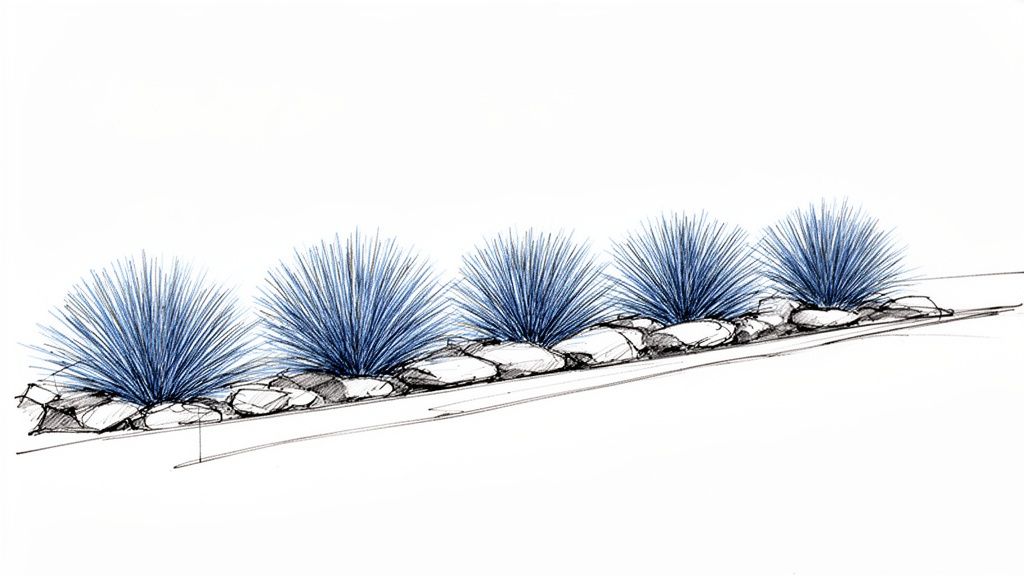
Blue Fescue thrives in full sun and requires excellent drainage, making it perfectly suited for rock gardens, borders, and mass plantings. Its resilience in dry conditions makes it a staple for low-water gardens. While it can tolerate a range of climates, its vibrant blue color is most pronounced in cooler regions with less humidity, making it a sustainable and attractive groundcover alternative.
Ideal Applications and Design Pairings
The cool, silvery-blue hue of Blue Fescue makes it a versatile design element, fitting beautifully into contemporary front yard borders in Northern California or as an accent in Colorado mountain home rock gardens. Its fine texture adds a softening touch to hardscapes and pathways.
Complementary Plants: Pair it with plants that offer contrasting colors and textures, such as the deep burgundy leaves of Heuchera 'Palace Purple' or the broad, silvery foliage of Artemisia 'Powis Castle'.
Mass Plantings: Use it as a groundcover by planting in large drifts to create a low-maintenance "meadow" effect that suppresses weeds and conserves moisture.
Container Gardens: Its compact size makes it an excellent "thriller" or "filler" element in container combinations, especially when paired with trailing succulents or vibrant annuals.
Actionable Tips for Success
To ensure your Blue Fescue remains vibrant and healthy, follow these key recommendations:
Plant in Groups: Arrange clumps in odd-numbered groups of 3, 5, or more for a natural, cohesive look. Space them approximately 12-18 inches apart to allow for mature growth.
Ensure Excellent Drainage: This grass is intolerant of "wet feet." Amend heavy clay soils with sand or compost to improve drainage and prevent root rot.
Divide to Rejuvenate: Every 3 to 4 years, divide the clumps in the spring to reinvigorate the plant and maintain its tidy, mounded shape.
Visualize Color and Spacing: The cool tone of Blue Fescue can dramatically alter your yard's color palette. You can apply AI Landscape Design to visualize your ideas using photos of your own yard. This lets you preview how its silvery-blue hue will look next to your existing plants and hardscaping, helping you perfect color combinations and spacing before planting.
As landscaping adapts to changing environmental conditions, using resilient plants like Blue Fescue is a key part of building a sustainable yard. You can explore more on how technology is shaping this trend by reading about AI-driven climate adaptation strategies.
5. Desert Willow (Chilopsis linearis)
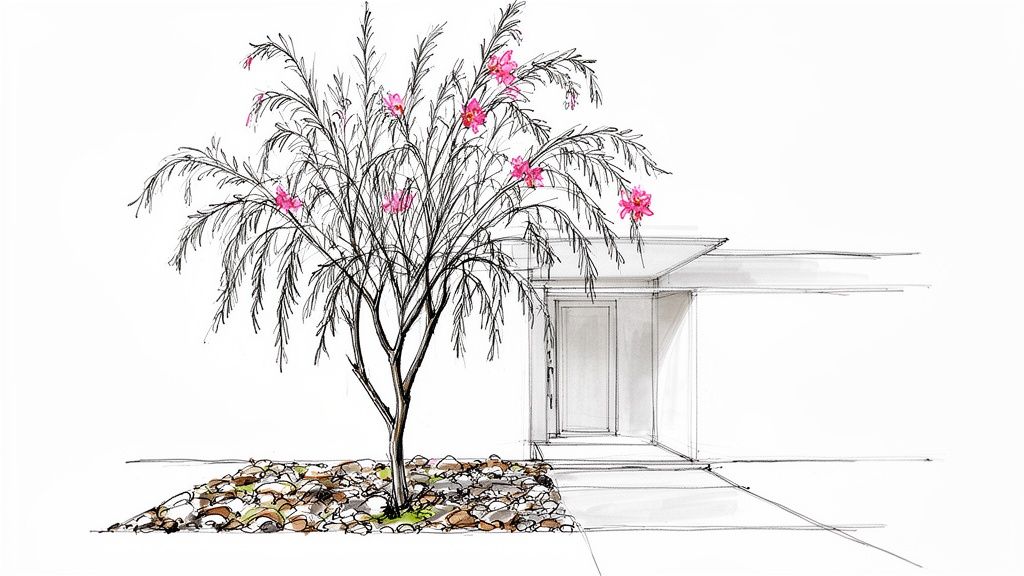
For homeowners desiring the elegance of a small tree without the high water demand, the Desert Willow is an exceptional choice among drought tolerant plants for a front yard. Despite its name, it's not a true willow but a stunning native of the Southwestern U.S. that produces fragrant, orchid-like flowers from spring through fall. Its airy, open structure and sculptural, twisting branches provide visual interest even in winter, making it a beautiful, low-maintenance focal point.
This deciduous tree is celebrated for its resilience, thriving in full sun and well-draining soil with very little supplemental water once established. Its deep root system allows it to access moisture far below the surface, making it perfectly adapted to arid climates. The vibrant blooms, typically in shades of pink, burgundy, and white, are also a major draw for hummingbirds, adding life and movement to your landscape.
Ideal Applications and Design Pairings
The Desert Willow’s graceful form makes it a versatile addition to various xeriscape designs, from native gardens in Arizona and New Mexico to small, water-wise yards in Southern California. It offers dappled shade without overwhelming a space, making it perfect for smaller front yards.
Complementary Plants: Underplant it with vibrant, low-growing perennials like Desert Marigold or Blackfoot Daisy to create a layered, colorful composition. Its fine-textured foliage also contrasts beautifully with bold succulents like Agave or the upright structure of Red Yucca.
Focal Points: Train it as a single-trunk tree to anchor a corner garden bed or plant a multi-stemmed variety as a natural-looking screen near a patio or window.
Mulch Choice: Apply a layer of organic mulch like shredded bark to retain soil moisture and suppress weeds, or use decomposed granite for a clean, desert-style aesthetic.
Actionable Tips for Success
To cultivate a healthy and beautiful Desert Willow, consider these practical tips:
Training and Pruning: Decide early whether you want a multi-stem shrub or a single-trunk tree. Prune in late winter to remove dead or crossing branches and to shape the canopy for the desired form.
Watering Wisely: Provide deep, infrequent watering during its first one or two years to establish a strong root system. Mature trees are extremely drought-tolerant but will flower more profusely with occasional summer water. To optimize this process, explore how to use AI-powered sensors for automated irrigation.
Visualize Mature Size: A Desert Willow can grow 15-25 feet tall and wide. You can apply AI Landscape Design to visualize your ideas using photos of your own yard. This ensures you can see its mature size and placement relative to your home and other plants, ensuring it won't overcrowd the space or block important views.
6. Catmint (Nepeta × faassenii)
For a soft, billowy texture and a season-long display of color, Catmint is an exceptional choice among drought tolerant plants for a front yard. This aromatic perennial features waves of lavender-blue flowers atop mounds of fragrant, gray-green foliage. It offers a cottage-garden feel with the rugged resilience needed for a low-water landscape, thriving in full sun and poor soils once established.
Catmint is celebrated for its incredibly long bloom period, often from late spring until the first frost, providing continuous interest with minimal effort. Its ability to tolerate heat, drought, and even deer makes it a workhorse in sustainable garden design. After its first year, it requires very little supplemental water, thriving on natural rainfall in many climates and only needing occasional drinks during severe drought.
Ideal Applications and Design Pairings
Catmint’s versatile nature makes it a star performer in a variety of landscape styles, from Mediterranean-style front borders in California to pollinator gardens throughout the Midwest. Its informal, mounding habit softens hardscapes and fills gaps beautifully.
Complementary Plants: Pair it with other tough perennials like Russian Sage (Perovskia atriplicifolia), Desert Marigold (Baileya multiradiata), or Gaura to create a vibrant, water-wise plant community. The cool tones of Catmint contrast wonderfully with yellow and pink flowers.
Borders and Walkways: Use it as a fragrant, informal edging along walkways or driveways where its soft foliage can spill over the edges, creating a relaxed and inviting look.
Mulch Choice: Apply a layer of organic mulch like shredded bark to help retain soil moisture and suppress weeds, though it also performs well with gravel mulches in drier climates.
Actionable Tips for Success
To get the most out of your Catmint and ensure it becomes a low-maintenance highlight in your garden, follow these key tips:
Mass Planting: For the greatest visual impact, plant Catmint in odd-numbered groups of 3 or 5. Spacing them 18 to 24 inches apart will allow them to grow into a continuous, flowing drift of color.
Encourage Reblooming: After the first major flush of flowers fades in mid-summer, shear the entire plant back by about one-third. This encourages a fresh flush of growth and a second wave of blooms that lasts into the fall.
Visualize Your Border: The soft, spreading nature of Catmint can be hard to plan on paper. You can apply AI Landscape Design to visualize your ideas using photos of your own yard. This is a great way to see how a mass planting will look along your walkway or foundation, helping you perfect the scale and color combinations before planting.
7. Lantana (Lantana camara & Lantana horrida)
For homeowners desiring a blast of continuous, vibrant color with incredible heat and drought tolerance, Lantana is a top-tier choice. This workhorse shrub produces abundant clusters of flowers in fiery shades of red, orange, yellow, pink, and white, often creating a multi-toned effect as the blooms mature. Its ability to thrive in scorching sun and with minimal water once established makes it a brilliant addition to any low-water front yard garden.
Lantana is exceptionally low-maintenance, flourishing in full sun and a wide range of well-draining soils. Its relentless blooming season, typically from spring through the first frost, provides long-lasting curb appeal and attracts a steady stream of pollinators like butterflies and hummingbirds. After its first year, it requires very little supplemental water, easily handling intense summer heat and making it a foundational plant for sustainable, colorful landscapes.
Ideal Applications and Design Pairings
Lantana’s cheerful, tropical appearance makes it highly versatile, fitting perfectly into butterfly gardens throughout the South, Mediterranean-style landscapes in Southern California, and vibrant, water-wise front yards in Texas and Arizona. Its mounding or trailing habit allows it to function as a groundcover, a focal shrub, or a container "spiller."
Complementary Plants: The bright colors of Lantana pop against the silvery foliage of plants like Artemisia or dusty miller. Pair it with the bold, spiky forms of succulents or the soft textures of ornamental grasses like Purple Fountain Grass for a high-contrast design.
Mass Plantings: Use a single color of Lantana in a mass planting for a dramatic, unified groundcover effect, or mix different varieties for a lively, cottage-garden feel.
Container Gardens: Trailing varieties are perfect for spilling over the edges of pots and hanging baskets, providing season-long color for patios and entryways.
Actionable Tips for Success
To ensure your Lantana provides a stunning and healthy display of color in your landscape, follow these key tips:
Strategic Pruning: Prune Lantana back hard in early spring to remove any winter damage and encourage vigorous, new growth. This helps maintain a compact, tidy shape.
Establishment is Key: Water newly planted Lantana regularly for the first year to develop a deep, resilient root system. Once established, its water needs are minimal.
Visualize Color Combos: The sheer number of Lantana color varieties can be overwhelming. You can apply AI Landscape Design to visualize your ideas using photos of your own yard. This allows you to see how a 'Miss Huff' orange-pink will look next to a 'New Gold' yellow before you commit to buying.
8. Desert Rose (Adenium obesum)
For homeowners desiring a splash of exotic, tropical color without the high water demand, the Desert Rose is a spectacular choice among drought tolerant plants for a front yard. This succulent shrub features a dramatic, swollen trunk base (caudex) that stores water and produces a profusion of brilliant pink, red, or white flowers. Its sculptural form and vibrant blooms offer a unique aesthetic that feels both lush and water-wise.
Desert Rose is exceptionally well-suited for hot, dry climates and thrives with minimal intervention once established. It demands full sun to produce its signature flowers and requires extremely well-draining soil, making it a perfect candidate for containers, raised beds, or rock gardens. After its first growing season, it needs very infrequent watering, particularly during its winter dormancy, solidifying its status as a low-maintenance gem.
Ideal Applications and Design Pairings
The unique, bonsai-like appearance of the Desert Rose makes it a standout feature in container gardens in Southern California and a perfect fit for Mediterranean-style homes in Arizona. It serves as a living sculpture that provides a burst of color against neutral-toned walls or gravel beds.
Complementary Plants: Pair it with fine-textured groundcovers like Silver Carpet (Dymondia margaretae) or low-growing succulents such as Echeveria to highlight its bold structure.
Focal Points: Use a mature Desert Rose in a decorative container near an entryway or on a patio to create a powerful, artistic focal point that draws the eye.
Mulch Choice: Surround in-ground plantings with inorganic mulch like sand or small pebbles. This enhances drainage and prevents the root and caudex rot that can be caused by moisture-retaining organic mulches.
Actionable Tips for Success
To ensure your Desert Rose thrives and becomes a show-stopping element in your landscape, follow these key tips:
Prioritize Drainage: Plant in a cactus or succulent mix amended with sand or perlite to provide the sharp drainage this plant needs to prevent rot.
Container Planting: In regions with frost, planting in a container is ideal. This allows you to easily move it indoors or to a protected location during winter.
Visualize with AI: The unique shape of a Desert Rose can be hard to place. You can apply AI Landscape Design to visualize your ideas using photos of your own yard. This helps you virtually position different container and plant combinations to find the perfect spot to showcase its beauty before you commit.
9. Esperanza (Tecoma stans)
For homeowners desiring a burst of vibrant, long-lasting color with minimal water, Esperanza, or Yellow Bells, is an exceptional choice. This fast-growing shrub is celebrated for its brilliant, golden-yellow, trumpet-shaped flowers that bloom prolifically from spring through fall, even in intense heat. Its lush, green foliage provides a stunning backdrop to the flowers, creating a tropical feel that defies its incredible drought tolerance.
Esperanza is remarkably low-maintenance and thrives in full sun and well-draining soil, including poor or rocky ground. Its ability to withstand hot, dry conditions makes it one of the most reliable drought tolerant plants for a front yard in warm climates. Once established after its first year, it requires very little supplemental water, typically only during the most prolonged periods of drought. This resilience makes it a perfect addition to a water-wise garden that doesn't sacrifice visual impact.
Ideal Applications and Design Pairings
Esperanza's cheerful color and upright form make it a versatile player in various landscape styles, from tropical front yards in South Florida to water-wise desert gardens in Arizona and Texas. It's also a magnet for hummingbirds, adding life and movement to the garden.
Complementary Plants: Create a striking color contrast by pairing its bright yellow blooms with the deep purples of Salvia leucantha or the vibrant oranges and reds of Lantana.
Backdrop Planting: Use its height and dense foliage as a vibrant green backdrop for lower-growing perennials and succulents.
Accent Shrub: Plant a single Esperanza as a stunning focal point near a mailbox or entryway, or plant in groups of three for a powerful statement of color.
Actionable Tips for Success
To ensure your Esperanza provides a dazzling and healthy display, follow these key strategies:
Prune for Shape: In late winter or early spring, prune the plant back hard to control its size, encourage bushier growth, and promote a more prolific bloom cycle.
Deadhead for More Blooms: While not strictly necessary, removing spent flower clusters will encourage the plant to produce even more new blossoms throughout the season.
Visualize Before Planting: Esperanza can grow quite large, often reaching 6-8 feet tall. You can apply AI Landscape Design to visualize your ideas using photos of your own yard. This helps you ensure its mature size won’t overpower the space or block a window, perfecting its placement before you plant.
10. Texas Privet (Forestiera pubescens)
For homeowners desiring a resilient, native shrub that offers year-round structure with exceptional drought tolerance, Texas Privet is a superb choice. This hardy, deciduous to semi-evergreen plant provides a backdrop of fine-textured foliage and delicate, fragrant white flowers in early spring. Its ability to thrive in poor soils and withstand extreme dry conditions makes it a cornerstone among drought tolerant plants for a front yard, particularly for sustainable and water-wise landscapes.
Texas Privet is remarkably low-maintenance once it has established its root system. It flourishes in full sun to part shade and adapts to a variety of soil types, from clay to rocky loam. After its first year, it needs very little supplemental water, surviving on natural rainfall alone in many regions. This adaptability makes it an invaluable asset for creating eco-friendly gardens that support local wildlife.
Ideal Applications and Design Pairings
Texas Privet’s versatile nature makes it a perfect fit for sustainable native gardens in Texas and water-wise front yards throughout the Southwest. Its dense growth habit is ideal for creating natural privacy screens or serving as a foundational backdrop plant.
Complementary Plants: Pair it with other Texas natives like Esperanza (Tecoma stans), Texas Sage (Leucophyllum frutescens), and various Salvias to create a cohesive, low-water ecosystem in your front yard.
Structural Planting: Use it as a formal hedge along a property line or train it into a small, multi-stemmed tree to create an interesting focal point. Its subtle beauty allows more colorful perennials to stand out.
Mulch Choice: Apply a layer of native mulch, such as shredded hardwood or oak leaves, to help retain soil moisture, suppress weeds, and enrich the soil as it decomposes.
Actionable Tips for Success
To successfully integrate Texas Privet into your landscape for long-term beauty and resilience, consider these practical tips:
Strategic Placement: Plant it where it has room to reach its mature size (up to 12 feet tall and wide) to avoid constant pruning. It works well as a backdrop for shorter plants or as a screen for unsightly views.
Selective Pruning: To maintain a natural shape, prune selectively in late winter or early spring after flowering. It can be shaped into a formal hedge or pruned to encourage a more tree-like form.
Visualize Before Planting: The final look of a native garden depends on texture, form, and layering. You can apply AI Landscape Design to visualize your ideas using photos of your own yard. This is an excellent way to see how a row of Texas Privet will look as a privacy screen or how a single specimen will anchor a garden bed, ensuring your design supports both aesthetics and local ecology.
10 Drought-Tolerant Front-Yard Plants Comparison
Plant | Complexity 🔄 | Resources & Care ⚡ | Expected Outcomes ⭐📊 | Ideal Use Cases 💡 | Key Advantages ⭐ |
|---|---|---|---|---|---|
Agave (Agave americana & A. parryi) | 🔄 Moderate — needs well‑draining soil, adequate spacing, placement away from traffic | ⚡ Very low water after establishment; minimal pruning; sensitive to root rot | ⭐📊 Dramatic, long‑lived focal point; dies after bloom (rare) | 💡 Xeriscapes, rock gardens, accent near entry; plant in odd groups | ⭐ Extreme drought tolerance; architectural form; low maintenance |
Russian Sage (Perovskia atriplicifolia) | 🔄 Low — straightforward planting; requires annual pruning to avoid legginess | ⚡ Very low water after establishment; prune in spring; may self‑seed | ⭐📊 Long bloom (Jun–Oct), airy texture, strong pollinator value | 💡 Mass plantings, borders, prairie/contemporary designs | ⭐ Extended bloom, aromatic foliage, low maintenance |
Desert Marigold (Baileya multiradiata) | 🔄 Low — simple planting in very free‑draining soils; spacing for spread | ⚡ Very low water; no deadheading; may reseed in ideal conditions | ⭐📊 Bright, near‑continuous yellow blooms in warm climates; low height | 💡 Rock gardens, small front yards, pollinator patches | ⭐ Continuous blooms, extreme drought tolerance, low upkeep |
Blue Fescue (Festuca glauca) | 🔄 Low — compact habit; needs excellent drainage and periodic division | ⚡ Very low water after establishment; divide every 3–4 years; avoids humidity | ⭐📊 Year‑round blue/silver foliage and fine texture; low profile | 💡 Borders, containers, rock gardens, low‑height accents | ⭐ Striking foliage color; year‑round interest; low maintenance |
Desert Willow (Chilopsis linearis) | 🔄 Moderate — small tree form needs pruning, space, and root consideration | ⚡ Very low water after establishment; annual pruning; frost‑sensitive | ⭐📊 Fast growth, fragrant orchid‑like blooms (May–Sep), provides shade | 💡 Focal tree/shrub, hummingbird gardens, small yard specimens | ⭐ Showy flowers, fast structure, strong pollinator draw |
Catmint (Nepeta × faassenii) | 🔄 Low — easy to grow but can spread or become leggy without pruning | ⚡ Very low water; cut back in spring; divide every 2–3 years | ⭐📊 Long bloom (May–Sep), aromatic foliage, pollinator‑friendly | 💡 Mass borders, walkways, low‑water gardens, edging | ⭐ Long bloom period, hardy, affordable, low maintenance |
Lantana (Lantana camara & L. horrida) | 🔄 Moderate — vigorous growth; may be invasive in warm areas; needs pruning | ⚡ Low to very low water once established; fast‑growing; frost tender | ⭐📊 Continuous vibrant blooms (June–frost); high wildlife attraction | 💡 Butterfly gardens, containers, tropical/warm borders | ⭐ Continuous color, heat and drought tolerance, rapid fill‑in |
Desert Rose (Adenium obesum) | 🔄 High — requires excellent drainage, frost protection, and careful siting | ⚡ Very low water; slow growth; best in containers in cool climates | ⭐📊 Exotic sculptural form with large showy flowers (spring–summer) | 💡 Container focal points, tropical‑themed yards, botanical displays | ⭐ Unique caudex form; spectacular blooms; long‑lived in suitable zones |
Esperanza (Tecoma stans) | 🔄 Moderate — fast growth needs pruning to control size; can reseed | ⚡ Low to very low water after establishment; prune late winter | ⭐📊 Prolific golden trumpet blooms (May–Nov); fast structure and impact | 💡 Backdrop shrubs, hummingbird gardens, warm‑climate focal planting | ⭐ Profuse flowering, fast growth, tolerant of poor soils |
Texas Privet (Forestiera pubescens) | 🔄 Low to Moderate — slow‑growing; minimal pruning for shape; multi‑stem habit | ⚡ Very low water; highly adaptable to poor soils; native species benefits | ⭐📊 Year‑round structure; spring fragrant flowers; supports local fauna | 💡 Native/sustainable landscapes, screening, backdrops in Texas region | ⭐ Native, drought‑hardy, ecosystem support, low maintenance |
From Photo to Paradise: Visualize Your Dream Yard with AI
Transforming your front yard from a high-maintenance, water-intensive space into a resilient, beautiful landscape is no longer a distant dream. Throughout this guide, we've explored a powerful roster of ten exceptional drought tolerant plants for your front yard, from the architectural drama of Agave and the feathery grace of Russian Sage to the vibrant, long-lasting blooms of Lantana and Esperanza. Each plant offers a unique combination of texture, color, and form, providing the essential building blocks for a stunning, low-water garden that thrives in challenging conditions.
We’ve moved beyond simple identification, delving into the practical specifics that empower you to succeed. You now have actionable insights on USDA hardiness zones, precise sun and soil requirements, and crucial maintenance tips for establishing a water-wise ecosystem. The journey from inspiration to implementation, however, often hits a stumbling block: visualization. How do you translate this curated list of plants into a cohesive design that complements your home’s unique architecture and your personal style?
Bridging Imagination and Reality with Technology
This is where the abstract concept of a new landscape meets the tangible reality of your own property. Guesswork, sketches, and costly trial-and-error installations are becoming relics of the past. Modern AI-powered tools provide a revolutionary bridge, allowing you to see your vision come to life before a single shovel hits the dirt.
By leveraging an AI Landscape Design application, you can bypass the uncertainty that often paralyzes homeowners. You can apply AI Landscape Design to visualize your ideas using photos of your own yard. The process is remarkably straightforward yet incredibly powerful:
Start with Your Canvas: Simply upload a photo of your existing front yard. This isn't a generic template; it's your actual home, with its specific lighting, shadows, and architectural features.
Generate Instant Ideas: Let the AI generate a multitude of design concepts. You can see how a Desert Willow would look as a focal point near your entryway or how drifts of Blue Fescue grass could elegantly line your driveway.
Experiment and Refine: Swap plants in and out. Test different combinations of the perennials, grasses, and shrubs we’ve discussed. See how Catmint pairs with Russian Sage or how Desert Marigolds add a pop of yellow against your home’s siding. You become the designer, iterating on ideas in seconds.
This ability to visualize and modify designs digitally is not just for landscaping. For those eager to experiment with digital design in other areas, exploring the best virtual staging software options can help you visualize your landscape ideas before breaking ground, offering a broader perspective on how technology is reshaping home improvement.
From Digital Blueprint to Flawless Execution
The true value of this technology extends beyond personal experimentation. Once you've crafted a design that you love, you have a clear, visual blueprint to guide the entire project. This visual reference is invaluable for communicating your vision with clarity and precision. You can share the AI-generated images and augmented reality walkthroughs directly with a landscape contractor or local nursery staff, ensuring everyone is perfectly aligned on the final goal.
This eliminates misunderstandings about plant placement, scale, and density, leading to a more efficient, cost-effective, and ultimately more successful installation. You are no longer just describing a garden; you are showing them the finished paradise. By embracing these tools, you are taking control of your home’s curb appeal, creating a landscape that is not only environmentally responsible and resource-efficient but also a beautiful, personalized extension of your home. You've curated your plant list; now it's time to bring that vision to life.
Ready to stop guessing and start seeing? Take the next step and visualize these drought-tolerant plants in your own yard with DreamzAR AI Landscape Design. Download the app, upload a photo of your space, and let AI generate stunning, personalized landscape designs in seconds. DreamzAR AI Landscape Design makes professional-quality design accessible to everyone.